Data Centers
Eastern Iowa city passes tough data center restrictions after months of opposition
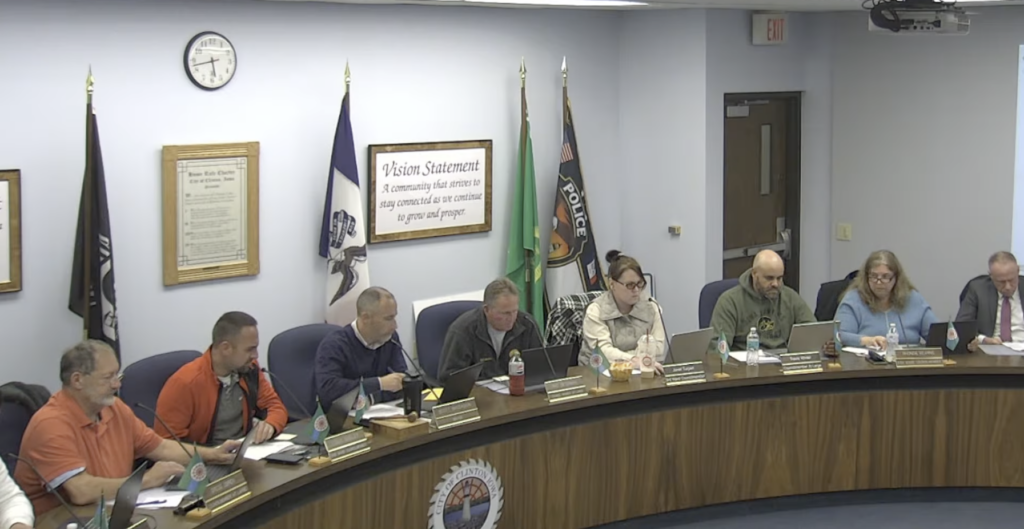
Residents showed up to the Clinton City Council in Iowa on Tuesday night, many wearing “Say no to Data Centers” T-Shirts.
And while local leaders didn’t say no, per se, they did make it much harder for data center developers to get approvals.
The Clinton City Council adopted restrictions on data center development Tuesday, giving itself greater oversight of agreements between developers and neighboring landowners after months of public opposition.
The measure passed 6-1. The council added air quality to its review criteria and gave itself approval authority over private agreements permitting shorter setbacks, the required distances between facilities and neighboring properties. Council member Janet Turpen dissented.
“Our duty is to stand up for these guys. These are our residents. These are the people who voted us in,” Clinton councilwoman Janet Turpen said. Data Center developer QTS has been among those residents said they feared would locate a project in their community.
“I don’t care how much money QTS has to spend,” Turpen said.
QTS, a Blackstone-backed data center developer that is also building a campus in Cedar Rapids, is exploring a facility in the Clinton area, according to the company. Several residents described the project as covering about 1,100 acres. QTS did not speak Tuesday.
Clinton, in eastern Iowa along the Mississippi River across from Illinois, had an estimated population of 24,049 in July 2025, according to the U.S. Census Bureau.
The ordinance sets different requirements depending on the size of a project such as the one QTS is exploring. A facility qualifies as hyperscale if its designed electrical load exceeds 40 megawatts, its site exceeds 40 acres or its buildings exceed 100,000 square feet.
Hyperscale facilities are allowed only in the city’s industrial park zoning district, which also permits smaller facilities. The heavy industrial district allows small and large data centers. Developers must count the land, building space and electricity requirements of all planned phases when determining project size.
Randy Heppner, who lives on Sarah Lane, asked why council members would not agree to a 1,500-foot setback.
The ordinance establishes a 1,000-foot setback for hyperscale facilities from residential dwellings, including those in nonresidential districts, residentially zoned properties, schools, daycares, hospitals, nursing homes, churches, public parks and places of public assembly.
The restriction also applies to outdoor equipment, including backup generators, cooling systems, electrical substations and battery storage systems. The minimum distance for large, non-hyperscale facilities is generally 500 feet. Both large and hyperscale facilities require at least 100 feet between principal buildings and exterior property lines.
Council members compared the distances with those at existing industrial facilities, including ADM, Atlas and LyondellBasell. One said a 1,500-foot setback would roughly double the land needed.
The ordinance also calls for earthen barriers at least 20 feet high, evergreen screening and buffers at least 300 feet wide for hyperscale sites adjoining designated sensitive properties, unless the developer and abutting property owners negotiate different arrangements. The barriers and vegetation must be in place before above-ground improvements are constructed.
Landowners and developers can negotiate shorter setbacks within the ordinance’s minimum requirements.
City Attorney Patrick O’Connell disagreed with residents who argued that private agreements amounted to an unlawful delegation of authority. After consulting the mayor, he offered an amendment transferring review from the zoning administrator to the council without changing minimum distances.
The council would not negotiate payments between the parties or determine the distance on their behalf. The agreements also would not override protections afforded to property owners who had not signed them.
Renee Peterson raised concerns about wells and soil testing Tuesday. The ordinance prohibits evaporative cooling and other water-intensive cooling methods. Water studies will identify sources, projected consumption and effects on local infrastructure, including neighboring wells and farm water systems that could be affected by groundwater removal during construction.
Owners of private wells and other water sources that could be affected can participate in testing before construction. If the project makes a protected water supply unsafe, unusable or substantially reduces its output, the data center owner and operator have to supply replacement water at no cost until a lasting solution has been independently verified.
At the Nov. 10 meeting, Debbie Holstein called for local air quality protections, including baseline testing and monitoring. On Tuesday, the council added air quality to its development review criteria. One member said state and federal environmental permits would apply and expressed support for considering an air quality study when negotiating a development agreement, a contract specifying project obligations.
Residents questioned how far noise from data centers would carry. Normal operations must meet hourly average noise limits of 55 dBA, a measure weighted toward human hearing, and 65 dBC, which gives greater weight to low-frequency sound, at residential and sensitive locations. The city may reduce applicable limits by five decibels for tonal noise, such as a pronounced hum or whine. Operators are required to commission acoustic studies before construction and further evaluations after operations begin and after each major phase.
Developers have to submit plans for backup power, emergency response, traffic and eventual closure. Residents will have a public contact for complaints, and operators will certify compliance annually. The city can require further testing or corrective measures in response to credible complaints.
Carol McGuire, a Clinton resident, recounted six months of opposition, including an unsuccessful push for a moratorium and a petition she said garnered 1,300 signatures that were not accepted.
QTS describes its plans as early-stage and says it does not disclose specific power capacity for security and confidentiality reasons. The company’s project page says an initial site plan will be available when submitted to the city.
A lawsuit over a rejected citizen initiative is pending, O’Connell said. The city rejected the measure because its charter does not allow voters to enact zoning measures through that process. The attorney doubted the lawsuit would prevail but said a successful initiative would override conflicting provisions of the ordinance.
QTS projects thousands of construction jobs and hundreds of full-time positions.
The council next meets Dec. 8. No hearing on the QTS project is scheduled.
Leave a Reply