Data Centers
Not so Peachy: Ga. county reverses zoning for CyrusOne’s Project Peach data center
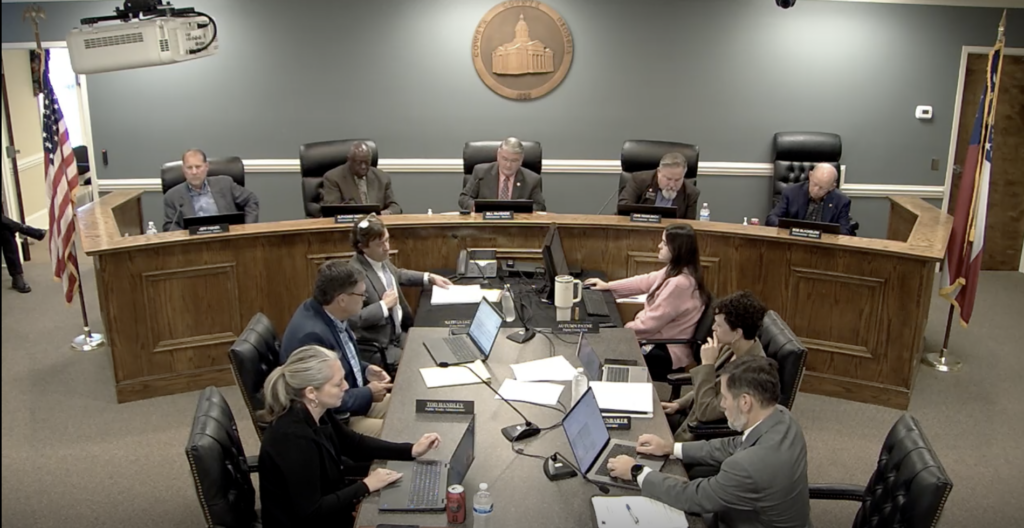
Coweta County commissioners voted 3-2 Tuesday to return a proposed 324-acre data center site southwest of Atlanta to rural conservation zoning, after the developer failed to meet key deadlines attached to its 2025 approval.
The vote followed a public hearing on Project Peach, a CyrusOne proposal along U.S. Highway 29, Weldon Road and Johnston Circle. County staff said the developer had submitted site plans for review and an agreement for temporary construction power, while a land disturbance permit and the power agreement commissioners originally required remained outstanding.
“Please do not allow financial contributions to substitute for accountability,” resident Sandra Faircloth told commissioners. She said the applicant had twice assured the board its power agreement deadlines were reasonable. “But promises mean nothing without accountability.”
Coweta’s vote follows local action on data centers in other states. Calvert County, Maryland, adopted a six-month moratorium Aug. 18 on data center site-plan applications and approvals while it reviews land-use, infrastructure and environmental impacts. Box Elder County, Utah, adopted a 180-day pause on accepting and processing new data center applications in June while it studies land-use rules. Coweta’s vote affected an already rezoned site that lacked a land disturbance permit and permanent power agreement. Residents asked commissioners to enforce the deadlines attached to Project Peach.
Coweta approved light industrial zoning for the property in April 2025, subject to 25 conditions. One required a will-serve letter and a power purchase agreement from an electric service provider within six months; the board later extended that deadline by a year. Another required a land disturbance permit by Oct. 16, 2026. At Tuesday’s hearing, zoning staff said the applicant provided an executed service agreement for temporary construction power on Oct. 16 and site development plans entered initial review Oct. 8. The permit had not been issued.
CyrusOne representative Brad Hout said Georgia Power’s request for land along a transmission corridor forced a redesign that moved planned buildings and set the schedule back a few months. He said the company had enough power for construction and a bridge to permanent service, while Georgia Power continued studying pending projects to sort out, in his words, “who’s real, who’s not.” County officials said the temporary agreement was with an electric membership corporation, or EMC; its commercial details were redacted.
By the Numbers: Project Peach Buildout Tracker
Hout said CyrusOne had spent $60 million to buy the property and another $2 million to $3 million with local consultants and contractors. He said the company had begun a U.S. Army Corps of Engineers review of minor wetland mitigation, applied for a Georgia Department of Transportation permit to widen the site driveway and filed a sewer extension request that CyrusOne would fund.
The developer also offered to follow the county’s newer data center ordinance through a proposed development agreement. Hout cited greater setbacks, closed-loop cooling and Tier 4 emissions generators, along with community contributions. County Administrator Michael Fouts said the draft agreement included road improvements and a proposed benefit payment. Hout said CyrusOne had not sought a tax abatement.
Residents questioned why those offers should excuse missed deadlines. Kathy Dozier, who attended the 2025 rezoning hearing, said CyrusOne had assured commissioners that six months would be enough to secure the original power agreement. “They made the commitments, and the applicant failed to meet that commitment,” she said.
Jeremy McAllister, a District 4 resident, said the applicant had acknowledged at an October 2025 hearing that it had no committed end user and that signing a power contract would trigger significant financial obligations. He asked whether CyrusOne was unwilling to commit without a tenant, “or is there a larger problem with available electricity?” He said the project had been described as needing about 700 megawatts and asked what transmission facilities that demand might require. McAllister said, “We’re submitting a constitutional objection,” arguing that approval of new zoning conditions in a development agreement would create a new zoning decision open to legal challenge.
Hout said customer demand had drawn CyrusOne to the Atlanta area. He argued that the risk of building without a tenant belonged to the company. “If we buy a $60 million property and we put $300 million in the ground, and we create a mission-critical facility, and no one shows up, that’s our risk,” he said.
Once the hearing closed, a commissioner moved to restore the land’s original rural conservation zoning. The motion passed 3-2. The county’s Oct. 21 recap lists the action as an approved reversion to rural conservation.
CyrusOne was still working through site review, related permits and permanent-power arrangements when the board voted.
Leave a Reply