Grid
DOE Scraps Three Transmission Corridors as Power Demand Climbs
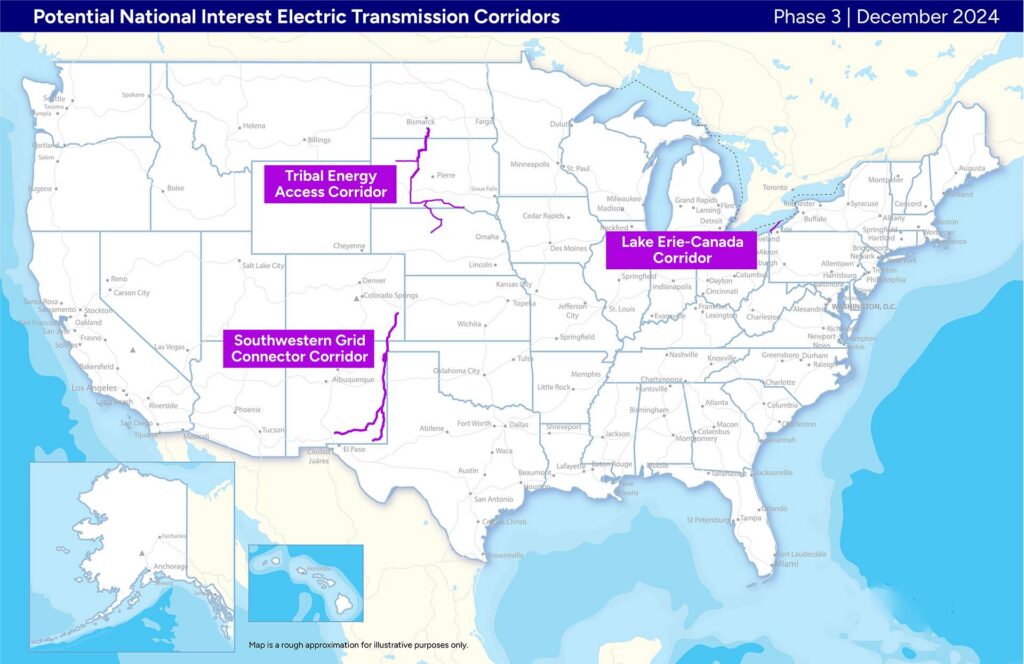
The Trump administration has ditched a series of new proposed power transmission corridors planned under his predecessor, alleging that they were only mapped out to appease a “climate-alarmist agenda.”
The transmission corridors would have boosted renewable power, which U.S. grids have increasingly tapped this year amid brutal heat waves and skyrocketing demand.
Energy Secretary Chris Wright announced Aug. 12, that the Department of Energy will abandon three proposed National Interest Electric Transmission Corridors advanced under the Biden administration. The decision ends a two-year designation process that drew organized opposition from ranchers, rural landowners and Republican lawmakers.
The three are the Lake Erie-Canada Corridor, the Southwestern Grid Connector Corridor and the Tribal Energy Access Corridor. Wright said an “extensive review, including public feedback and stakeholder input,” showed that the current designation process should not continue. Transmission policy, he said, “must serve the American people — not special interests or a climate-alarmist agenda that drives up costs, worsens reliability and disregards the concerns of local communities.”
Congress created the NIETC authority in 2005, but it remained largely unused until the Biden administration revived the designation process in 2023–24.
A designation does not approve a specific transmission line or transfer property to the government; it identifies areas where inadequate transmission harms consumers. That status can unlock a $2 billion federal loan program created by the Inflation Reduction Act, along with the Federal Energy Regulatory Commission’s limited backstop siting authority, including eminent domain under defined conditions.
DOE identified 10 candidates in May 2024, then narrowed the list to three that December. Canceling them removes that federal fast lane and leaves developers in those regions to rely on state-by-state permitting.
The reversal comes as U.S. electricity demand is climbing sharply, driven in part by data centers. Harvard University’s Belfer Center has cited projections that put data center power demand on track to exceed 1,000 terawatt-hours by 2030. Scrapping the corridors leaves the congestion they were intended to relieve to slower state processes as the grid needs more interregional capacity.
Opposition was strongest along the Southwestern corridor and centered on property rights. Cliff Copeland of the New Mexico Cattle Growers Association said his group stood “against a DOE land grab,” while county governments in southeastern Colorado warned that the corridor could let Washington seize “hundreds of thousands of acres.” The Western Landowners Alliance campaigned against a potential footprint that could run 5 to 15 miles wide.
Rep. Lauren Boebert, R-Colo., whose district sits inside the corridor, pressed Wright to stop the process and welcomed the cancellation. Critics generally framed their objections as procedural, not anti-transmission; even the Cattle Growers said they were “not against wind and solar,” only the way the corridor was imposed.
Supporters, including clean-energy groups, grid planners and Democratic lawmakers, said the corridors addressed a real bottleneck. Americans for a Clean Energy Grid called the designations “crucial to unlocking funding and making transmission permitting more efficient,” while NextEra Energy Transmission said its Lake Erie project “would enhance grid reliability.” Rep. Teresa Leger Fernández, D-N.M., had told constituents that a designation “does not approve a specific transmission project or acquisition of property,” leaving any actual line subject to state permitting.
DOE said it is not ending the NIETC program but “recalibrating” it around the 2026 National Transmission Needs Study. The department pointed to financing it has closed since October 2025, including a $1.6 billion loan guarantee for AEP Transmission, $26.5 billion for Southern Company subsidiaries, a $1.9 billion SPARK program and a $3.3 billion loan to AEP Texas.
The underlying projects are not dead. NextEra’s 73-mile, 1,000-megawatt Lake Erie Connector continues through Pennsylvania review with a targeted 2031 in-service date. Losing the designation removes a federal backstop but does not halt the line.
The Southwestern corridor’s central problem — congestion at the seam between the Eastern and Western interconnections — remains without a comparable federal solution. The Tribal corridor, meanwhile, loses its clearest financing path for high-voltage lines serving five Upper Great Plains reservations. The Oceti Sakowin Power Authority had cited the designation as a way to unlock federal money for those projects.
Rob Gramlich of Grid Strategies called the reversal evidence that the NIETC framework “is … dysfunctional.” Designations that are “reversed with each new administration,” he said, give developers little reason to rely on them.