Data Centers
In New England’s Knowledge Corridor, a new Data Center Pause Moves Forward
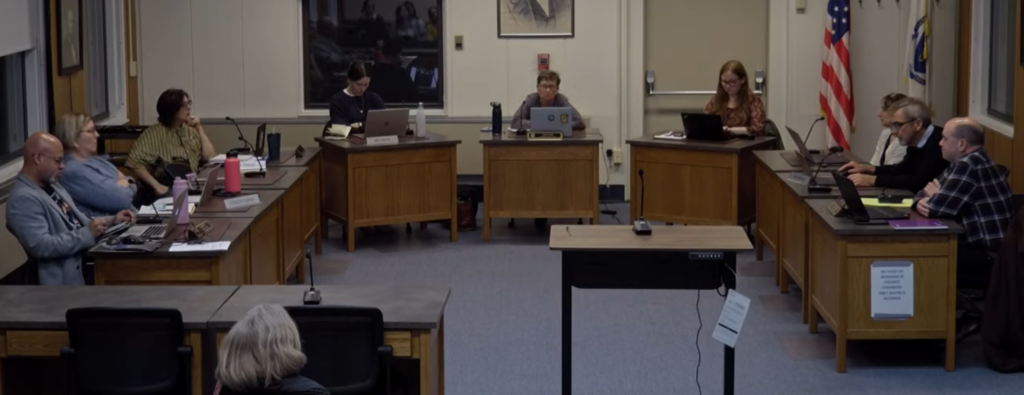
Northampton, Massachusetts, moved toward a one-year halt on new data centers Oct. 29, as two city panels recommended a moratorium following public testimony about environmental, electricity-cost and surveillance concerns and debate over how broadly to define the facilities.
The City Council’s Committee on Legislative Matters and the Planning Board backed sending the proposal to the full council. The ordinance would prohibit data center permitting, construction, conversion and establishment for 365 days while a separate select committee studies permanent regulations. The full council must vote to adopt it.
Councilor Chris Stratton said that because notice of the hearing has been published, the moratorium is effectively in place until the council votes. Under state zoning law, an adopted amendment applies to building and special permits issued after the first notice of its hearing, which was published Oct. 1.
“I have a lot of fear for my future, but I’m here because I have hope,” said Rachel Wheatley, a Smith College environmental science student who urged the city to act before damage becomes irreversible.
Northampton, a city of about 31,000 residents, sits in the Knowledge Corridor, a region of 32 colleges and universities that stretches from Hartford, Connecticut, to Greenfield, Massachusetts.
Data centers used 4.4 percent of U.S. electricity in 2023, and that share could reach 6.7 percent to 12 percent by 2028, according to a Lawrence Berkeley National Laboratory report released by the U.S. Department of Energy in December 2024. Northampton’s ordinance cites moratoriums adopted by other Massachusetts cities and towns as data center development spreads in the state.
The city’s proposed ordinance says its existing zoning, land use and development regulations make no specific provision for data centers, either by right or by special use permit. It identifies concerns about water, electricity and land consumption, along with noise and lighting.
The council referred the measure, Ordinance 26.125, to the two panels Sept. 3. The measure was recommended by Councilors Laurie Loisel, Rachel Maiore and Gwen L. Nabad. Its purpose is to give elected officials, city staff and residents time to assess commercial data center impacts and recommend regulations to the council and the mayor.
The proposed definition covers a facility, or part of one, primarily designed or used to house computer servers and related infrastructure for storing, processing, managing or transmitting electronic data. It lists cooling systems, substations, backup generators and telecommunications equipment among possible components. It also says a data center would not be classified as an office, warehouse, manufacturing or research use.
That wording prompted questions about ordinary businesses, colleges and telecommunications providers. Stratton wanted a threshold below which equipment would fall outside the definition. He said businesses need clear expectations about server rooms or small installations they might add during the year.
Stratton, who first proposed 500 kilowatts, lowered his proposal to 250 kilowatts. He also cited a 2,500-square-foot threshold he said Easthampton uses and floated 1,200 square feet. He later clarified that a limit would apply to space or power devoted to the relevant equipment, rather than an entire business. Both recommendations advanced without a numerical threshold. Stratton said he would not stand in the way of sending the measure to the council but would prefer a floor below which a facility is not considered a data center.
“I like laws and regulations that establish a clarity of expectation,” Stratton said.
Loisel, who chairs the Committee on Legislative Matters, said a more specific definition could lead developers to argue their projects fall outside it. She said detailed definitions are the select committee’s work as it drafts permanent rules. Planning Board Chair Janna White raised concerns about unintentionally restricting server equipment that supports other uses.
Councilor Garrick Perry favored moving the proposal forward quickly. He said extended discussion of detailed definitions could delay getting the study committee working and protecting residents.
“The one thing I’ll say, and I said this in city council meeting when we first brought this up, is that I think time is of the essence,” Perry said.
Several Smith students urged the city to go further with a full ban. Wheatley described concerns about water consumption, carbon emissions, noise and land use. She said preventive action could protect her generation’s future. Bella Quiroa, also a Smith student, said facilities built to support generative AI should be specifically banned. She backed a wattage threshold, an appeal process for local businesses and putting community well-being ahead of economic and technological gains.
Maya Faulstich, another Smith student, supported the moratorium and, ideally, an outright ban. She argued that data center expansion could increase pressure on drinking water and electricity infrastructure and impose costs on residents.
Planning Board member Samuel Taylor said local property and energy costs would discourage development and that no data center of the type under discussion has been built in New England. He also challenged the proposed floor-area thresholds and said he was uncomfortable assigning an energy limit he did not understand.
“I just don’t understand what we are doing outside of responding to a fear that exists right now,” Taylor said.
The draft would put pending data center applications on hold and bar approval of any data center application during the moratorium. Its review provision directs the committee to examine environmental, public health and infrastructure impacts to inform permanent zoning. If the city adopts permanent regulations before the moratorium expires, the temporary restriction would end when those rules take effect.
The written proposal also allows one extension with a committee request and majority council approval. White asked to remove “to” from a clause saying the moratorium could be “extended to 180 days,” so the extension would read as an additional 180 days.
With that change and one extension, the moratorium could run 545 days. Only the Planning Board’s recommendation included the change. Maiore, the council president, said the council could add it and could amend the moratorium during the study process if the committee identifies a problem.
The full City Council is expected to take up the proposal Nov. 5, Loisel said. That meeting will include public comment but not a formal public hearing. The select committee has been named and is expected to begin work soon and take public input as it develops recommendations. Maiore said more than 30 residents applied to serve on it.