Nuclear
What Japan Is Teaching U.S. Nuclear Leaders This Week
Amazon, Google, Microsoft, and Oracle are racing to secure enough electricity for the next generation of AI data centers, and nuclear power has become the industry’s favored answer. Utilities and hyperscalers have committed to roughly 10 gigawatts of new nuclear capacity for computing loads.
Much of that depends on small modular reactors, or SMRs, that have yet to receive a single U.S. operating license. The demand is already here. Most of the hardware is not.
This week, a delegation from Japan brought U.S. regulators a possible way to close part of that gap. Their presentation includes years of studies in how to safeguard SMRs against geologic shocks.
During the briefings—mostly behind closed doors—representatives from the Japan Atomic Energy Agency and two major engineering firms, IHI Corporation and JGC Corporation, briefed NRC staff on a design most American nuclear leaders have never had to consider: a reactor platform that floats.
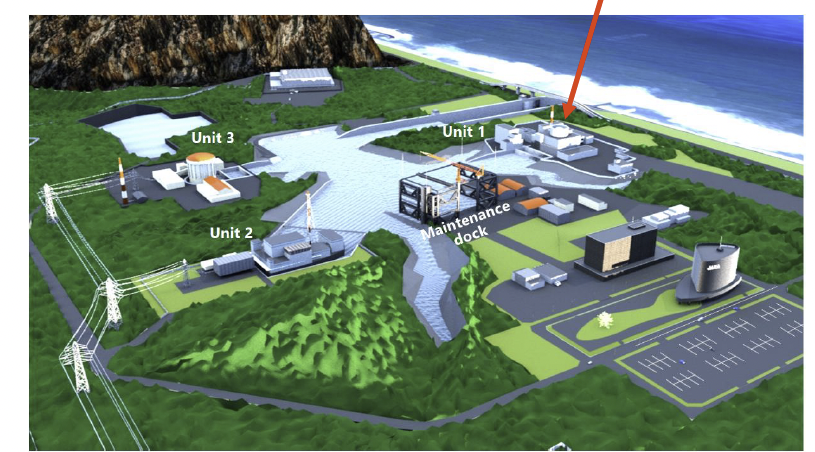
The group, known as the JAEA Consortium, is developing the Floating Seismic Isolation System, or FSIS. The system places an SMR and its safety-related structures on a platform in a shallow pool instead of anchoring them to bedrock. Air cavities and orifices in the platform absorb earthquake motion, while buoyancy supports the plant’s weight. It works passively, with no activation required, and relies on ordinary steel, water, and air. There are few moving parts.
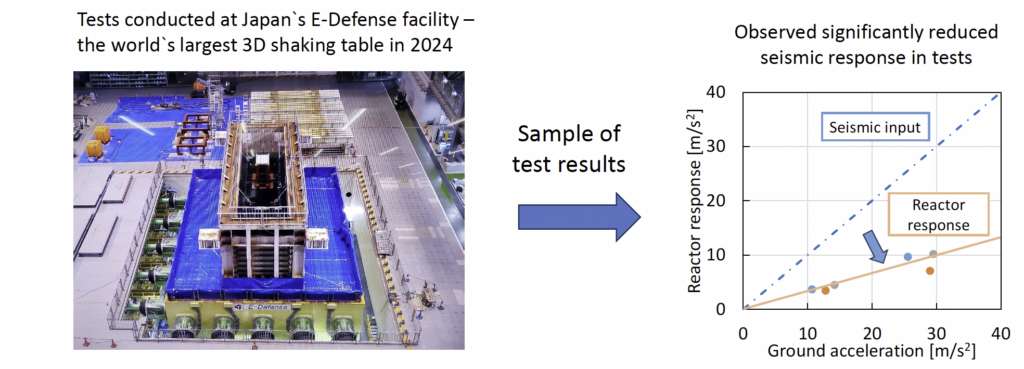
The performance claim is straightforward. Under the design’s site envelope, a safe-shutdown earthquake could produce horizontal ground motion of 2.0 g. A reactor on the FSIS platform would experience 0.5 g. Vertical motion would fall from 1.0 g to 0.5 g. The consortium tested a large-scale mockup in 2024 at Japan’s E-Defense facility, the world’s largest three-dimensional shaking table, and reported seismic reductions consistent with those targets.
For data center developers, the larger payoff is siting flexibility. If the platform controls the shaking that reaches the reactor, the same reactor design can be used at sites with very different seismic conditions without a fresh round of engineering for each location. That would broaden the pool of viable sites and make SMR designs easier to standardize. The locations that work best for data centers, close to fiber, electricity demand, and water, do not always work for a reactor anchored directly to the ground.
The Japanese team is not in Maryland to sell equipment. It is laying the groundwork for a regulatory review
The consortium is pursuing Standard Design Approval from the NRC under 10 CFR Part 52. The August meetings are pre-application discussions, the early and nonbinding stage when a developer and the regulator work out what a future application will have to demonstrate. The consortium also filed three white papers under docket number 99902114: one covering the FSIS seismic design methodology, another on validation and verification of its seismic analysis methods, and a third with preliminary design information for the combined reactor-and-platform unit, called the FSIS-R.
Those papers make limited claims. They map the regulations, NRC guidance, and industry standards that will govern the design, and they outline a multistage seismic analysis framework. They do not present a finished plant ready for licensing. The consortium’s roadmap puts the heavier filings, including formal topical reports, a probabilistic risk analysis, and a safety analysis report, in 2026 and 2027. A compliance analysis against the NRC’s general design criteria is scheduled for 2028. This week’s meetings are the start of that process.
They also add a new chapter to a 70-year nuclear partnership.
The United States and Japan signed their first civil nuclear cooperation agreement in 1955, and Japan built most of its commercial fleet on American light-water reactor designs licensed from General Electric and Westinghouse. The relationship endured the Three Mile Island accident in 1979 and the Fukushima disaster in 2011. Fukushima led Japan to shut down its reactors and pushed nuclear power’s share of the country’s electricity below one percent. Japan began reversing course in 2023, and in February 2025 its cabinet approved an energy plan that committed the country to building new reactors for the first time since Fukushima.
Now the money is moving in the other direction. For decades, nuclear technology and capital flowed from the United States to Japan. In 2025, under a broader $550 billion investment framework, Japan pledged as much as $332 billion for U.S. energy and nuclear projects. That included up to $100 billion to support Westinghouse AP1000 and SMR construction, plus another $100 billion for small modular reactors such as GE Vernova Hitachi’s BWRX-300.
If the current buildout takes shape, some of the reactors powering America’s data centers could be financed with Japanese capital and mounted on Japanese-designed platforms. The meetings in Maryland gave U.S. regulators their first full look at how that might work.