Data Centers
In Greensboro, N.C., some feel ‘sold out’ by politicians. They don’t want billionaires to be next.
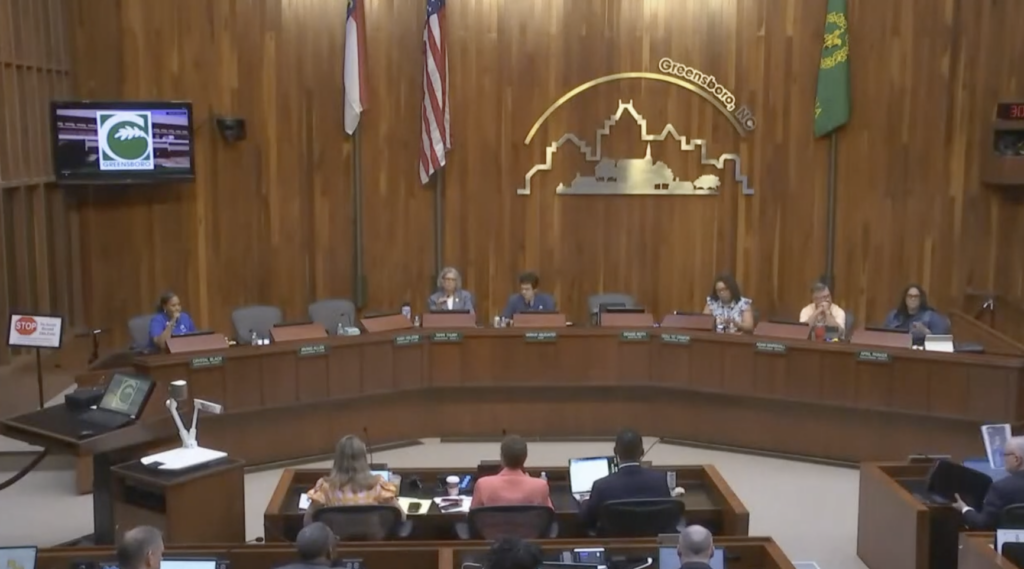
Residents warned leaders of water, power, noise, surveillance, and inequity as the City Council weighed a four-month pause — and its Dream Center project faced fresh questions.
For more than 90 minutes on Monday, Greensboro residents came to City Hall with policy proposals, a recording of the relentless, craze-inducing hum from a Michigan data center, and a blunt message for elected officials:
A 120-day pause on large data centers is not nearly long enough.
Speaker after speaker asked for 32 months — the maximum pause they said North Carolina law would allow — to study power, water, pollution, noise, utility rates, and the industry’s use of nondisclosure agreements. Some asked for an outright ban.
“We already feel sold out by Washington,” said Jack Flowers, a Greensboro small-business owner who works in insurance. “I don’t want to feel sold out to billionaires here at home.”
The proposed moratorium would stop new data centers demanding more than 10 megawatts of electricity for 120 days while Greensboro writes an ordinance. “120 days is there because it sounds longer, but it’s just four months,” resident Danny Giles said.
When time ran out, to make room in the meeting hall for a Planning and Zoning Board meeting (as happens in local government), the Council said it would resume public comment at its regular Tuesday meeting. No final moratorium vote had been taken.
That leaves Greensboro in the middle of a remarkable reversal. The Council rejected moving ahead with a moratorium by a 5-4 vote last month, then agreed unanimously two weeks later to advance the 120-day proposal after sustained public pressure.
The opposition on Monday was broad, detailed, and, at times, furious. Residents warned that diesel backup generators could worsen air pollution, round-the-clock cooling equipment could hammer nearby neighborhoods with noise, and new water and grid demands could land on ratepayers. Others tied AI infrastructure to surveillance, job displacement, and military targeting.
Much of the argument was also about process. Residents said a four-month clock running through the holidays would leave no time for independent environmental studies, a resident-led steering committee or public meetings in the neighborhoods most likely to host industrial development.
“It reeks to me as political theater,” said musician and freelance creative Ashley Virginia Blackmon. “You’ve held this meeting at 4:00 p.m. on a workday. I think that you’re buying time, hoping that our outrage dies down, that we forget about this.”
There was little defense of the industry from the lectern. Sebastian Ocampo, a UNC Greensboro computer-science student, offered the closest thing to a middle path: use the pause to explore an “ethical data center” powered by renewable energy and paired with community or educational space.
George Hartsman reduced the water question to a refrain: “We live at the top of a watershed and we don’t have a river.” He repeated himself, taking a long pause each time to let it sink in.
The equity argument has particular weight here.
Greensboro is a 308,667-person city where Black residents are the largest racial group, at 41.5 percent, and 17 percent of residents live in poverty, according to the U.S. Census Bureau. Several speakers said historically Black East Greensboro — home to North Carolina A&T State University — has already borne more than its share of environmental burdens.
“We’re not getting jobs. We’re not getting money,” said Rebecca Narciso of the Party for Socialism and Liberation. “We’re not getting any infrastructure for ourselves, for our students, for our teachers.”
At the center of the controversy is the Dream Center, a project pitched four years ago as a community-oriented digital campus at Gateway Research Park South.
ImpactData, an Atlanta-based firm founded by HBCU alumni Terry Comer and David Calloway, originally described a 110,000- to 115,000-square-foot mixed-use building: a 10-megawatt colocation facility, higher-education innovation center and workforce space tied to N.C. A&T.
The plan promised 28 permanent jobs and more than $108 million in investment. The City Council approved an incentive of up to $530,359, later transferring the agreement to Dream Center GSO1 LLC, an entity created by ImpactData’s owners, according to city records.
The ownership and development stack has since widened. Gateway is a nonprofit joint venture of N.C. A&T and UNC Greensboro. Data center developer Raeden joined ImpactData, and the companies now market a build-to-suit, AI-ready facility with no publicly named anchor tenant.
The latest Raeden project sheet advertises 20 megawatts in the initial phase, scalable to more than 100 megawatts across 38 acres.
Whether the project is as far along as that pitch suggests is less clear.
During questioning Monday, City Attorney Lora Cubbage said the Dream Center’s site plan expired last summer and no replacement has been approved. She also said a data-center-focused building would require rezoning because the property is zoned for public and institutional use.
“The city did not approve for a data center to go at Gateway Research Center,” Cubbage said. “What the city approved was for incentives.”
The disclosure issue reached the dais, too. Greensboro’s Mayor Pro Tem Denise Roth asked to be recused from moratorium and ordinance votes because she serves on Gateway’s board. The council granted the request, even though the city attorney found no direct legal conflict.
The upshot: The 120-day pause remains pending, the Dream Center remains alive but procedurally unsettled, and residents are demanding a much longer clock.
Michelle Kennedy, one of the final speakers before the recess, put it this way: “One hundred and twenty days is performative. Thirty-two months is due diligence.”