Data Centers
In Rural Indiana, a Polite Discussion over Data Center Rules
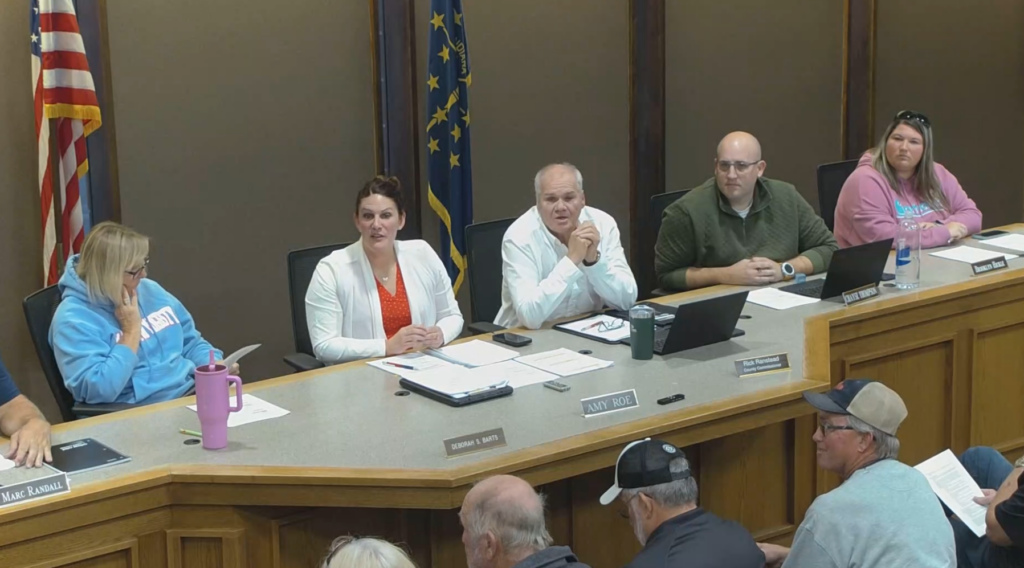
Fulton County, a rural Indiana community, grappled last night with proposed data center rules amid a drumbeat of national controversies over the industry’s rapid buildout.
After a couple of hours of nitty-gritty discussions of concerns, of science, and of what rules should look like, the county’s Area Plan Commission took no vote. Instead, as its members listen to neighbors, they took notes.
Members publicly reviewed four pages of a nine-page ordinance draft, then stopped with plans to examine the rest at a later meeting. Officials described the Oct. 26 session as a discussion of how the rules would work; a formal public hearing is still to come.
“Our role was not to say there’s no data centers,” said Richard Solano, a member of an advisory committee to the county commission, which created the draft rules. “Our role was to say what can we do to protect our community? What kind of guidelines can we put into these businesses.”
The Area Plan Commission, a 13-member county board administers Fulton County’s zoning and other land-use ordinances, including building, floodplain and unsafe-building rules. In this case, it is reviewing proposed standards for where data centers could be built and what safeguards applicants would have to meet before the county considers an ordinance.
The draft sorts facilities by electric design capacity: small at up to 10 megawatts, medium above 10 through 50 megawatts and large above 50 megawatts. It would place large projects in an intensive-use district with a special exception.
Those facilities would need to stand 500 feet from side and rear property lines and 1,500 feet from churches, schools, hospitals and nursing homes.
For Fulton County, this is not just an academic or civic exercise.
Earlier this year, Decennial Group, a Hammond-based data center developer, proposed building a large data center campus near the town of Akron in Fulton County. The company, co-founded by David Pavlick, is already building a 180-megawatt facility with CoreWeave in Hammond. In Akron, it floated a campus of about 300 acres, backed by $100 million to $150 million for supporting infrastructure such as roads, bridges and water upgrades.
Decennial never filed a formal application and never settled on a site. It pitched the plan at community open houses, including a contentious session at the Akron Banquet Hall on Feb. 4, 2026, that drew more than 40 residents. Opposition organized quickly.
In February, the Fulton County Area Plan Commission voted 6-1 to recommend a one-year moratorium on new data centers. The county Board of Commissioners adopted it in March on a 2-1 vote. The moratorium took effect immediately and runs for one year. It pauses approval of data center construction permits and freezes recent zoning amendments that took effect Jan. 1, 2026.
During the pause, an appointed committee will study the economic and environmental effects of putting data centers on farmland.
The commission’s document, which was the topic last night, has a point to resolve: one section allows some smaller facilities by right, while another appears to require a special exception for every data center.
Practical enforcement occupied much of the discussion. Residents asked whether a 500-foot separation from homes would be enough to address continuous equipment noise; at least two called for 1,000 feet. The board also weighed how lighting and landscaping rules would perform once a facility was built.
“How are you going to be able to actually stop the light? And then the part about the trees—the trees take a while to grow, so it’s going to take a while before they can actually get high enough,” asked Diana Baumgart, a public commenter.
The pressure reaches far beyond northern Indiana. A June 2026 Lawrence Berkeley National Laboratory report projected that data centers could account for 11.8 percent of U.S. electricity use in 2030 under its reference scenario, with a scenario range of 9.5 percent to 15.3 percent. Those are projections, but they show why utility capacity has become central to siting decisions.
Statehouses are also taking up the issue. According to the National Conference of State Legislatures, lawmakers in 39 states introduced legislation concerning data centers and power in 2026, while 15 states considered bans or moratoriums. Fulton County’s debate shows how those broad questions turn into measurements on a local zoning map: megawatts, feet from a home, decibels at a property line and gallons used for cooling.
Fulton County had an estimated 20,091 residents in July 2025, according to the U.S. Census Bureau. Its 2020–2024 American Community Survey figures put median age at 42.3 years and median household income at $61,360, in 2024 dollars. In a county of that size, even a single facility above the draft’s 50-megawatt threshold would be a substantial land-use decision, with effects reaching beyond its parcel.
Speakers at the Area Plan Commission work session referred repeatedly to a developer’s interest in land near Akron. One said the site under discussion covered 100 to 160 acres, a figure the county has not confirmed in the draft.
Another asked for a building-size measure alongside megawatts so residents could picture the project’s footprint. A county official said floor area alone would not show how much electricity a facility would require.
Noise and water remained prominent concerns. One resident compared the draft’s 55-decibel limit with a brewing coffee maker; another warned of low-frequency noise from equipment running around the clock.
The proposal calls for a noise study, property-line sound limits, restricted use of backup generators and closed-loop water or air cooling. It also calls for drainage, fire-response and road-use plans, along with a plan for eventual removal.
County commissioners adopted a one-year moratorium on data center permits in March on a 2-1 vote, giving officials time to consider permanent rules. A speaker at Monday’s meeting urged the commission to use that time and raised the possibility of extending the pause.
The commission still must work through the final five pages, reconcile provisions in the draft and hold a public hearing before it can make a recommendation. The county lists its next Area Plan Commission meeting for Nov. 23 at 6 p.m. in Rochester; the ordinance has not been confirmed for that agenda.
Leave a Reply