News
Ypsilanti’s vote against U-M, Los Alamos data center puts city alongside township opponents
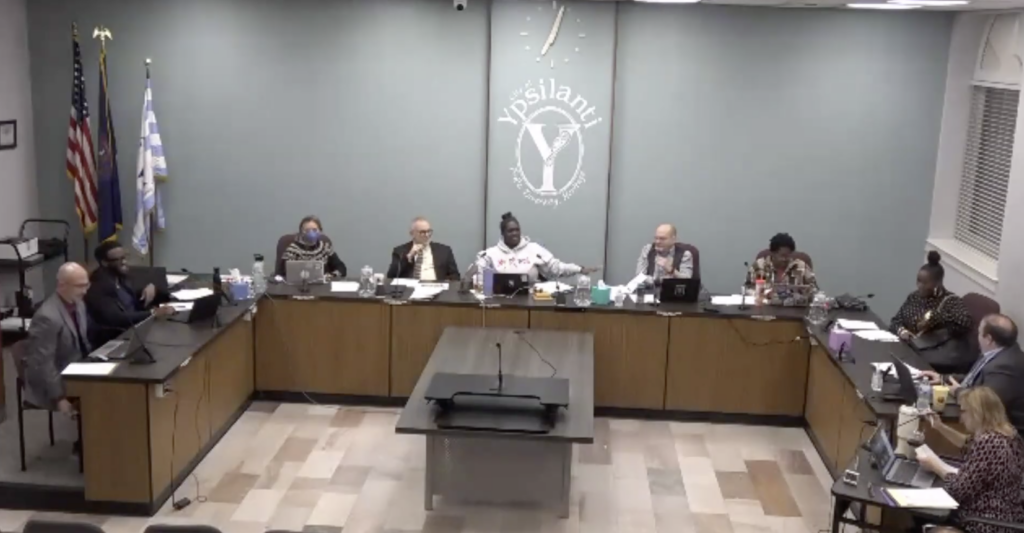
Ypsilanti City Council voted unanimously to oppose the University of Michigan and Los Alamos National Laboratory’s proposed research computing center in neighboring Ypsilanti Township. The Oct. 21, 2025, vote gave the city a formal position on a project outside its boundaries. Council members said city residents could face effects on shared water and electric systems.
The 7-0 vote on Resolution 2025-222 called for “a complete and permanent cessation of all efforts to build this data center in any form.” It asked the Ypsilanti Township Board to use “all available means to deny permits and prevent the development.”
It asked the university to end its partnership with Los Alamos, and the Washtenaw County Board of Commissioners to oppose the project. It asked DTE Energy and the Ypsilanti Community Utilities Authority to withdraw utility services, the Michigan Economic Development Corporation to drop its support, and the Michigan Strategic Fund to revoke a $100 million state grant. The council also directed the city clerk to apply for membership in Mayors for Peace and added state House and Senate appropriations committees to the list receiving the resolution.
“Just because you can do it doesn’t mean you should do it,” Council Member Patrick McLean said during the meeting. “And we really should expect better from the University of Michigan.” McLean said the university was making decisions with “no consideration for its host community and no consideration for its neighboring jurisdictions.”
He said that after speaking with the city attorney, he understood state law allows state-chartered universities to do so without going to host or neighboring communities.
The project has advanced since that vote. U-M selected a 144-acre site along Textile Road as its preferred location in August 2026. The university describes a $1.25 billion campus with a roughly 240,000-square-foot federal research facility, a roughly 50,000-square-foot academic facility and a DTE Energy substation that U-M says it will fund and that will serve only the facility. Its current plan starts at 50 megawatts of power demand and allows for as much as 100 megawatts. The Michigan Strategic Fund approved up to $100 million for the project on Dec. 10, 2024, when its cost was estimated at $830 million. Michigan House and Senate appropriations committees also approved the grant that month.
U-M says its building would support open academic research, while the federal facility would handle national research and security work, including classified research. Los Alamos’ work there would include computational modeling related to the safety and reliability of the existing U.S. nuclear stockpile, according to the university. U-M says there will be “no hazardous nuclear materials on site and no manufacturing of any kind,” including plutonium pits.
Council Member Amber Fellows, who introduced the resolution, said Ypsilanti and surrounding areas were “still being directly implicated” in nuclear weapons modernization through Los Alamos. The resolution also cited “excessive water consumption and potential PFAS forever chemical contamination,” attributing those concerns to reporting by Inside Climate News and The Guardian. Fellows said some environmental effects might not occur. “Maybe it won’t happen, maybe it will,” she said, adding that she agreed with a commenter who asked, “why even find out?”
Residents who spoke before the vote raised similar objections. One asked council to oppose the project because of possible effects on utilities, the environment and the community’s role in nuclear weapons work. Another cited potential PFOS releases and water use, and said Los Alamos could not be trusted on environmental effects. A solar advocate who said he was “not pro or against the data center” said a system that recirculates the same water has “no consumption of water,” unlike evaporative cooling. “I don’t think water is an issue,” he said. He objected to building on a green field and pointed to a vacant existing building as an alternative.
McLean focused on the siting process and unanswered questions about the facility’s use and operation. Council Member Desirae Simmons said the city had reason to weigh in even though the site is in the township: residents rely on shared water infrastructure and an electric utility whose decisions extend across municipal lines. She said a bill passed at the state level contains a “loophole” under which infrastructure such as a new substation would be “partly paid for by the rest of us.”
The U.S. Census Bureau estimates Ypsilanti city’s population at 19,766 in 2025. Its median household income was $46,588 in 2020-2024, and 24.8 percent of residents lived in poverty.
The Ypsilanti Township Board urged elected officials in August 2025 to oppose the project at its proposed sites. On March 31, 2026, the board adopted a resolution opposing a Los Alamos nuclear research facility anywhere in the township, citing what it called a “Tier I High Value Target Risk” and superseding its earlier request that U-M and Los Alamos locate the project on the former General Motors property at Willow Run, which is leased to the American Center for Mobility. On April 15, 2026, the township board asked the Ypsilanti Community Utilities Authority to stop services for data centers. On April 22, 2026, the authority adopted an immediate moratorium on committing water and sewer service to data centers and similar computing facilities, pending completion of due diligence investigations.
U-M says it is now conducting environmental studies and site-specific design work. It is reviewing cooling options, including closed-loop systems and reclaimed wastewater, and says it plans to leave about three-quarters of the property as green space.
The university’s published schedule calls for environmental studies and community engagement through March 2027, construction design and procurement during 2027, construction beginning late that year and initial operations in 2030. U-M held community town halls on Sept. 9 and Oct. 1, 2026.