Data Centers
‘Not the Way to Go’: A Small City In Jersey Makes a Statement on AI and Data Centers
Two ordinances would close the city’s zoning code to data centers and remove the use from a redevelopment plan.
In a small New Jersey city on Tuesday, the band played on in the face of national controversy. Linden, New Jersey, moved to ban data centers from every zoning district.
The City Council unanimously introduced two measures. Ordinance 70-53 would define data centers and list them as a prohibited use citywide. Another would remove data centers as a permitted use from the redevelopment plan for Block 587, a site local officials are now examining. Both measures require a second reading before final adoption.
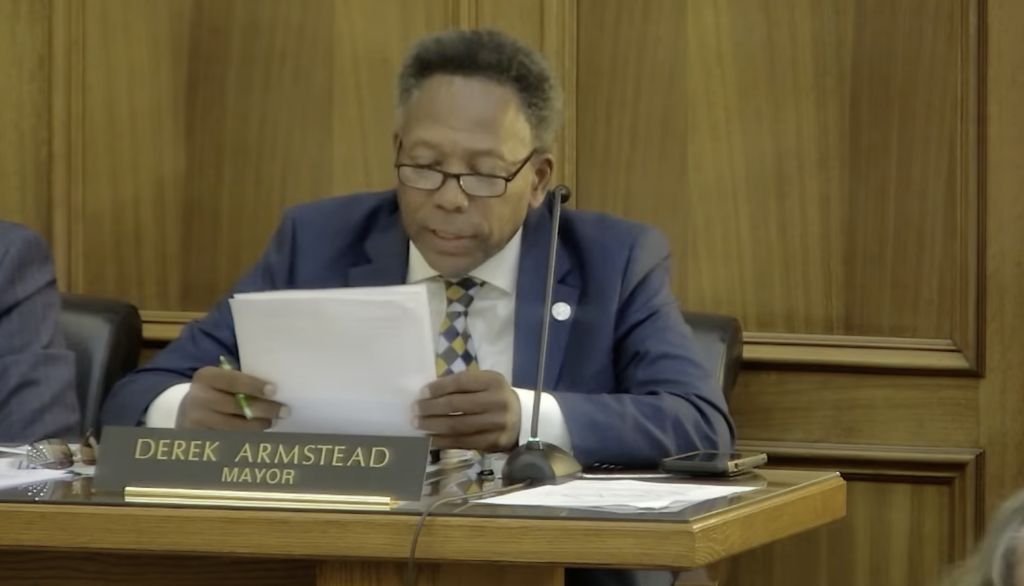
Mayor Derek Armstead said Linden had been approached by a developer interested in building a data center in the city. He did not identify the developer or give a project size, power requirement or proposed investment.
“We looked at the pros and the cons, and we realized that data centers just aren’t the way to go these days,” Armstead told the council.
Armstead cited electricity and water consumption, rising utility bills and what he described as limited permanent employment. He said the city could draw more jobs and long-term economic activity from another use at Linden Airport, a 96-acre general aviation property.
The mayor said a large pharmaceutical company is interested in the airport site and has discussed research, development and retail space. He gave no company name, timetable or investment figure. His comments framed the data-center ban as an economic-development choice as much as an environmental policy.
“Even if a data center gave us more money up front,” Armstead said, another development could offer stronger long-term growth.
Linden’s move lands in the middle of New Jersey’s effort to set statewide rules for the industry. Gov. Mikie Sherrill in May proposed requiring data centers to bring new clean generation online, contribute to grid upgrades, report energy and water use, negotiate community-benefit agreements and use local labor at prevailing wages. The governor called data centers one of the largest drivers of new electricity demand and tied the plan to the state’s affordability agenda.
The local ban takes a harder line. A city statement issued before the meeting said officials had reviewed potential effects on infrastructure, the environment and quality of life. Sixth Ward Councilman Eloy Delgado told the council that he viewed the ban as part of a broader need to regulate AI. Council President Michele Yamakaitis said the city should make clear through its zoning code that the facilities are not appropriate for Linden.
The administration’s case was also shaped by the Climate Action Revolution Network, a New Jersey youth advocacy group. City officials said Linden Board of Education Commissioner Brianna Armstead connected the group with municipal leaders during their review. A public commenter at Tuesday’s meeting said she had worked with the administration and council on both ordinances and was seeking similar restrictions elsewhere in the state.
The city’s pre-meeting announcement described the proposal as a ban on AI data centers. The ordinance title read aloud by the clerk was broader: it would define and prohibit data centers in all zoning districts. That language could cover conventional cloud and enterprise facilities as well as high-density AI projects. The final ordinance text will control how the ban is applied if the council adopts it.
The meeting also exposed gaps in the case presented by city officials. Armstead said data centers employ about 10 people. Employment varies widely by facility, and a major project less than five miles away carries a much larger commitment.
The region itself is grappling with the controversies and different communities in the Garden State are reacting differently.
CoreWeave plans to invest about $1.76 billion in a 392,600-square-foot AI data center at the former Merck research campus in Kenilworth. The New Jersey Economic Development Authority said the project is expected to create 143 full-time jobs, all tied to AI data-center operations, engineering, product development, information security and related technical work. The company qualified for a state award of up to $250 million over five years.
Kenilworth’s Planning Board approved the CoreWeave site plan in May 2025. The project has since drawn organized opposition over electricity use, noise, water, tax incentives and the approval process. Kenilworth officials have defended the project, saying it will use closed-loop cooling, operate within state noise limits and rely on its own power infrastructure. The borough is also negotiating a payment-in-lieu-of-taxes agreement and community benefits package.
The state approved CoreWeave’s Aspire tax-credit award in November 2025. NJEDA records show the company signed a 15-year lease and began construction in September 2025. The work includes renovating 284,500 square feet and adding 108,100 square feet. CoreWeave committed another $25 million to a collaboration with New Jersey universities, startups or similar organizations, according to the agency.
That project shaped the debate in Linden. A city official said the neighboring approval prompted conversations with Armstead, Delgado and other council members. The official also acknowledged that Linden’s 2020 redevelopment plan already listed a data center as a permitted use at the LPC site.
Carlos Rivas, a former Linden council member, accused the administration of hiding that history. He pointed to one of the proposals as evidence that the city had previously opened the property to data-center development.
The city official responded that the 2020 plan allowed a data center but did not specifically refer to an AI data center. He said Rivas was on the council when the plan was amended in 2023 and did not raise the permitted use then. The exchange showed why Linden is advancing two ordinances: one would bar future projects across the city, while the other would clean up an existing redevelopment plan that could otherwise leave an opening.
Public comments ran in both directions. One speaker, who said she had worked on more than 110 local ordinances and was pushing for a statewide moratorium, praised Linden for acting before an application reached the Planning Board. She warned that electricity and water effects cross municipal boundaries and urged residents to press officials in surrounding towns.
Resident Ed Kaminski, during a public comment period, asked the council to table the measures and produce the research behind them. He described AI as a technology with potential applications in medicine and research and said Linden should not close every possible site to data-center development. He also challenged Armstead’s employment claims and questioned whether the pharmaceutical prospect would materialize.
The arguments reflect the decision confronting municipalities across the PJM grid: accept a capital-intensive development that can expand the tax base, or reserve scarce industrial land and utility capacity for uses that may employ more people and impose lower demands on local systems.
Linden chose to close the door before a formal application forced that decision onto a planning board. The second readings will determine whether that position becomes law.
Leave a Reply