Data Centers
Indianapolis Puts New Data Centers on Pause — But Three Projects Stay in Motion
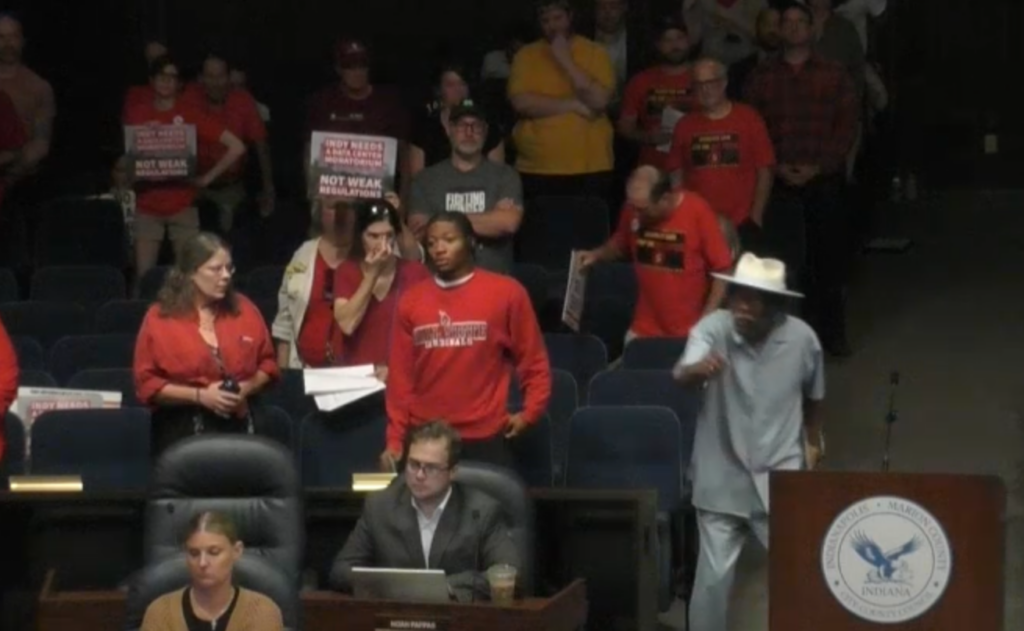
City officials moved a 16-month data center moratorium forward, but residents protested it didn’t go further.
Indianapolis put in a speed bump on new data centers Wednesday, after months of packed hearings, rewrites and a public argument over whether the city was writing rules quickly enough for an industry moving even faster.
The Metropolitan Development Commission approved the amended ordinance 6-0, completing its review of a moratorium already adopted by the City-County Council.
The measure stops new data center land-use approvals and related improvement location permits within the commission’s jurisdiction through the end of next year — roughly 16 months. It does not reach three projects that already secured land-use approval: Metrobloks in Martindale-Brightwood, Sabey in Decatur Township and DC Blox on the east side near Irvington.
Some residents expressed anger that the moratorium doesn’t last longer, hit harder, or include the approved projects.
“We’re not necessarily voting against data centers,” Councilor Dan Boots told the commission. “We’re pausing them until we have a chance to study them appropriately.”
Here’s what it does cover. The ordinance still gives Indianapolis a formal definition of a data center. It covers facilities primarily used to store, process, manage or transmit digital data, including server farms, cloud computing and artificial intelligence training. Incidental office IT, wireless communications facilities, substations, utility distribution nodes, public safety facilities and post offices are carved out.
Much of Wednesday’s legal debate centered on the exception for projects already in the pipeline. One commissioner said the phrase “permitting or allowance” was broad enough to raise questions about later permits for those sites.
The commission’s attorney cited Indiana’s Vested Rights Act, which generally preserves the rules in effect when an application was filed for three years. Planning officials said the moratorium applies prospectively, and commissioners were told they could only accept or reject the council’s text, not amend it.
The clock is meant to give the Department of Metropolitan Development time to convene technical experts, utility regulators and community members and return with a more durable rule book.
The ordinance specifically calls for work on campus size, building height and footprint, low-frequency noise, brownfields and subsurface testing, generator testing and electronic-waste plans. Staff said the process will also examine environmental and utility impacts.
Indianapolis has been trying to write that rule book since city planners began researching data center zoning last year, as Google pursued a 468-acre campus on the southeast side. Google later withdrew the proposal amid opposition, but the pipeline kept filling. Metrobloks, Sabey and DC Blox all won approvals under industrial zoning rules that were not written specifically for hyperscale computing facilities.
Metrobloks. Los Angeles-based Metrobloks won approval for a roughly 14-acre, $500 million data center on the former Sherman Drive-In Theater site near 25th Street and Sherman Drive in Martindale-Brightwood. The building would stand nearly twice as tall as typical area structures and sit closer to the road with fewer parking spaces than local standards recommend. The developer projected about $10 million a year in property taxes and pledged $2.5 million — potentially rising to $20 million with tax abatement — for affordable housing and neighborhood infrastructure. The City-County Council gave final approval in May 2026.
Sabey. Washington-based Sabey Data Centers is planning a campus of up to $4 billion and about 900,000 square feet in Decatur Township on the southwest side, along Kentucky Avenue near Camby Road. Two buildings would draw up to 250 megawatts, use a closed-loop cooling system and phase in between 2028 and 2030 on a site originally zoned for warehouses. Decatur Township residents sued to block the project.
DC Blox. Georgia-based DC Blox won a 6-1 commission vote in July 2026 for a roughly $2 billion, two-building campus with 31 diesel generators on the former Ford plant brownfield at the Thunderbird Commerce Center near South Kitley Avenue and the Pennsy Trail, close to Irvington. The company projects about 600 temporary construction jobs and 21 permanent positions. A week before the vote it scaled back the plan, shifting development toward the site’s core to add buffer space from Irvington Community Elementary School.
The department’s first answer was an SU-47 special-use district. The commission advanced it 5-3 last month with a 400-foot residential buffer, a 65-decibel property-line limit, water and power plans, annual compliance reports and a public dashboard. Council members instead stripped those standards from the bill, kept a revised definition and inserted the moratorium.
A council committee backed that rewrite 10-3, and the full council approved it 23-1 last week.
That change reflected an unusually large record. City documents say the city received 604 responses to its public-comment form, 40 more comments by email or mail and 884 comments tied to four individual projects over the previous year.
On Wednesday, most people in the room stood when commission President John Dillon asked who supported the moratorium.
One resident refused the simple choice. “I’m for it, but it doesn’t go far enough,” he said. The resident wanted the pause extended to the three grandfathered projects and warned commissioners, “Don’t make me say something that I’m not saying.” His protest was met with loud cheers from others who agreed.
The exchange grew heated before Dillon ended it and returned to the hearing.
The lone council vote against the moratorium, Michael-Paul Hart, also appeared Wednesday. He argued the city could “walk and chew gum at the same time” by enforcing the standards already drafted while continuing to improve them. Developers will keep planning during the pause, Hart said, and could emerge with an information advantage over council members taking office when the moratorium ends.
Indianapolis is joining a widening nationwide patchwork of local pauses. Calvert County, Maryland, just this week approved a six-month moratorium on new applications after an earlier two-year pause failed. Greensboro, North Carolina, is weighing a 120-day freeze after its council first rejected moving ahead 5-4, then voted unanimously to advance a pause under sustained public pressure.
The upshot: Indianapolis bought time, but not a clean slate. Three large projects can keep moving under the rules in place when they filed. Everything that comes next will wait while city staff tries to turn more than 1,500 comments, a year of controversy and a fast-changing industry into standards the public — and the next developer — can understand.