Data Centers
A Pause Near the Chesapeake Bay—For Data Centers
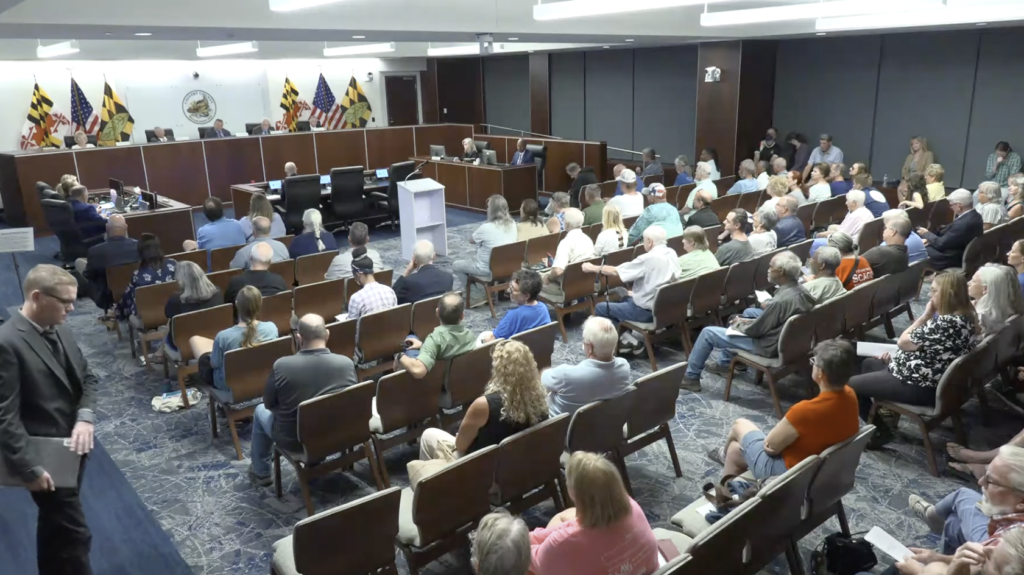
Calvert County, Maryland, kisses the Chesapeake Bay on one side, but will slow down a new, budding courtship with data centers the industry has been working on for a couple of years.
County commissioners approved a six-month moratorium on new data center site-plan applications Tuesday after residents packed a public hearing to demand stronger protections from an industry that has already reshaped local politics.
The measure stopped short of a stronger proposal. By the end of the hearing, the board had amended it to stop the county from accepting new applications for the resource-intensive projects during the six-month period. They will consider putting more teeth into it next month.
The distinction mattered to speakers who feared developers could keep filing, paying fees and advancing projects while the county rewrote its rules.
“That is not the strong pause the public has asked for,” resident Patrick E. Flaherty told commissioners. He urged an “ironclad” freeze and said Calvert residents were ready to fight for “a clean reset and real transparency.”
The pause came across like a half-measure. “I don’t think this moratorium as it stands has the teeth the public wants,” a commissioner, Catherine Grasso, said, calling for the county to reject new applications, restore earlier zoning and commission studies tailored to Calvert’s environment and infrastructure.
The vote is the latest turn in a conflict that began with two major proposals. Amazon Web Services sought a multi-building campus totaling about 2.4 million square feet near Constellation Energy’s Calvert Cliffs nuclear plant. AWS withdrew the application earlier this month, describing the reversal as a business decision.
A second proposal remains: Natelli Holdings’ Appeal Digital Park, a conceptual four-building, roughly 300-megawatt campus on 133 acres of county-owned, heavy-industrial land near a landfill and wastewater plant in Lusby.
The Calvert Cliffs site, minutes from Chesapeake Bay, also captured a central tension in the national buildout: data centers need enormous amounts of firm power, and nuclear plants offer existing generation and transmission.
Constellation Energy, the nation’s largest operator of nuclear power plants and the owner of Calvert Cliffs, has pushed state and federal rules for “co-locating” large customers beside generators, potentially reducing new grid connections.
One resident tried to put the region into perspective as commissioners mulled what to do.
“When I tell people I live in Calvert County, I don’t say, ‘I live in Calvert County by the nuclear power plant,’ or ‘I live in Calvert County by the liquid natural gas depot.’ I say, ‘I live in Calvert County by the Chesapeake Bay.’ That Bay and the historic Patuxent River define the southern part of this county. People moved here centuries ago to live near the water. They retire here and they vacation here because of the Chesapeake Bay. We owe it to future generations to protect this water, and I hope we can also preserve this wonderful way of life.”
Local residents against Data Center activity say that Calvert’s Bay-side geography, schools and neighborhoods make power availability only one part of the siting decision. AWS’s withdrawal ended one application, not the industry’s eager interest in the site.
Calvert has no operating data centers yet, but the proposals exposed how quickly hyperscale infrastructure can change a place before construction starts. County zoning rules that took effect in 2025 allow data centers only in industrial districts, with conditional approval required in the lighter-industrial zone.
Officials have also considered tighter standards for water use, wells, stormwater, emissions and developer-funded infrastructure.
Supporters see the projects as a way to add jobs and tax revenue while taking advantage of industrial land and nearby energy assets. Natelli has promoted a replacement regional park and projected major construction employment and county revenue.
Constellation, which is also restarting the former Three Mile Island nuclear plant, has championed regulatory pathways that could connect large loads near nuclear generation.
But Tuesday’s testimony showed that the central issue is no longer simply setbacks, cooling systems or megawatts. It is trust. Residents repeatedly cited confidential agreements, closed-door discussions and the feeling that they learned about potential projects only after important decisions were moving.
“Government transparency isn’t a favor granted when convenient; it’s an obligation,” Huntingtown resident Parker Coyer said. Danielle Pock, vice president of Citizens for Calvert, made the same point more broadly: “You cannot rebuild trust by telling residents to stop asking questions. You can only rebuild trust through listening, transparency, and a willingness to change course if necessary.”
That distrust has produced electoral consequences. In April, commissioners Todd Ireland, Mark C. Cox Sr. and Earl “Buddy” Hance voted against a two-year pause. All three then lost Republican primaries in June, while moratorium advocate Mike Hart survived and anti-data-center candidate Patti Stueckler advanced. At Tuesday’s hearing, candidate Ethan Cox summarized the movement’s sense of victory: “We beat Jeff Bezos, at least for the moment.”
The intensity reflects Calvert’s scale and geography. The Chesapeake Bay borders the county’s east side and the Patuxent River its west. The peninsula has just 213.19 square miles of land, a population estimated at 94,484, and an 87.2 percent owner-occupancy rate. In a stable, homeowner-heavy county that prizes rural character, industrial land-use decisions are personal as well as economic.
Calvert is not an isolated case. Local officials and residents across the country are slowing, rewriting or rejecting data center projects over power prices, water, noise, tax incentives and land use. Data Center Watch counted at least 75 projects worth about $130 billion blocked or delayed by local opposition in the first quarter of 2026 alone.
The backlash crosses party lines because the tradeoffs arrive locally even when the demand for computing is national.
The moratorium is therefore a pause, not a resolution. County government staff warned that specialized studies could cost seven or eight figures without a developer to fund them. County Attorney John B. Norris III said an outright ban would be more vulnerable to legal challenge than a time-limited moratorium.
Commissioners nevertheless discussed removing data centers from the zoning ordinance while they study noise, water, grid and environmental impacts.
Resident Mike Hart said he was prepared for that fight. “I’m not afraid of a fight,” he told the room. The board’s final motion stopped new applications for six months and passed without opposition.