Data Centers
North Dakota Lawmakers Confront the Systems Behind the Data Center Boom
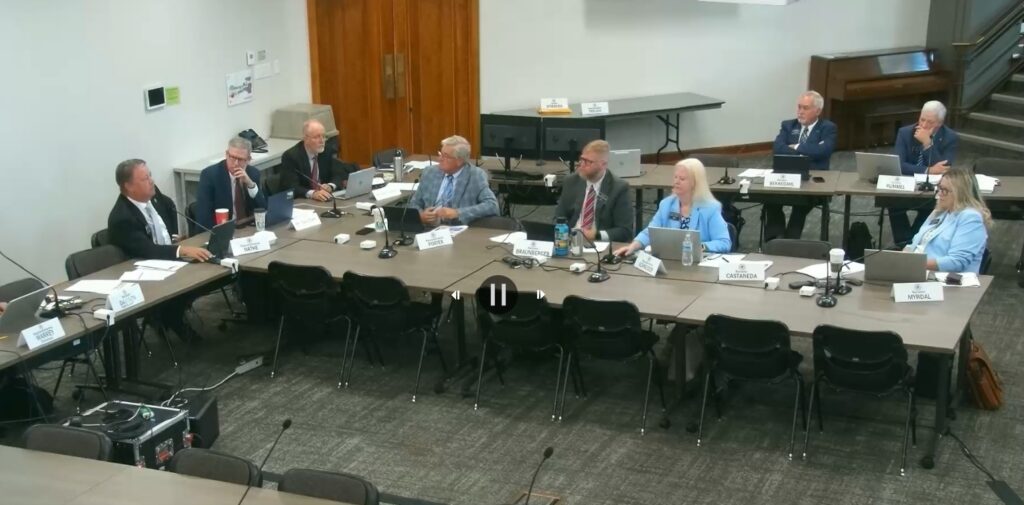
Over a full day of testimony Monday, North Dakota lawmakers heard two competing descriptions of the data center boom moving across the state.
To James Dickey, a Texas consultant and publisher of Hyperscale News, a data center is fundamentally “an industrial building with an unusually high value per square foot,” and North Dakota already has most of the tools it needs to manage the effects on power, water, roads and neighboring land. To Lynette Irwin, a retired teacher from Hazen who lives about five miles from a proposed 1.7-gigawatt campus, the building is only the most visible piece of a much larger transformation.
“We are talking about a system, not a building,” Irwin told the Legislature’s interim Artificial Intelligence and Data Center Committee. “We are talking about infrastructure, transmission, gas pipelines, fiber optic cable, roads.”
The distance between those descriptions framed the committee’s marathon hearing at the State Capitol in Bismarck. Developers and industry advocates urged lawmakers to treat data centers as another form of large industrial development, with familiar permits, contracts and local zoning rules. Residents and community advocates said projects measured in billions of dollars and gigawatts of power have exposed an imbalance between companies with deep technical and legal resources and rural governments that may have only weeks or months to understand what is being proposed.
By the time it was over, lawmakers had also heard that North Dakota has no established program for reclaiming an abandoned data center, that state regulators cannot guarantee a presidential pledge will insulate households from regional transmission costs, and that local governments retain broad siting authority even as some county officials say they need state help with bonding and other complex negotiations.
The 12-member panel, chaired by Rep. Jonathan Warrey, R-Casselton, is studying data centers ahead of the 2027 legislative session.
Existing rules, unprecedented scale
A long list of witnesses tried to make a case. Robert Mayo, a research specialist at North Dakota State University’s Challey Institute for Global Innovation and Growth, said states need transparency if they expect communities to trust developers. Dickey followed with a more confident argument: North Dakota has already regulated oil, coal, ethanol, wind and mining, and the questions surrounding data centers are neither entirely new nor beyond the state’s experience.
“What’s unusual here is the potential impact of the decisions in front of you,” Dickey said. He urged lawmakers to set measurable limits on noise, water use and other effects without dictating the technology companies must use to meet them. Grid contracts, he said, can require developers to pay for interconnections, make large deposits and curtail power use during emergencies.
Dickey pointed to Applied Digital’s projects as evidence that a large new customer can benefit other users. Applied Digital, a Dallas-based company traded on the Nasdaq, develops large data centers for artificial intelligence and high-performance computing; its Ellendale campus, called Polaris Forge, is the most advanced data center project in North Dakota, and the company is pursuing additional sites in the state. He said the company paid for a $110 million substation and power line at Harwood that Minnkota Power will own, without shifting the cost to Cass County Electric members. At Applied Digital’s Ellendale campus, he said, MDU’s profit-sharing credits could eventually reduce the annual bill of each residential customer by about $250 once the site is fully built.
Read More: What a Hyperscale Data Center Actually Needs: Power, Water, Land
The state’s Public Service Commission chairman, Randy Christmann, later offered a more guarded view. He said Ellendale has produced about $38 million in profit-sharing for MDU ratepayers over roughly three and a half years, with the annual benefit increasing as the campus grows. But he also cited a large load west of Williston that led to about $32 million in congestion charges for MDU over seven months before the Southwest Power Pool suspended them and litigation followed.
“There’s the two flip sides over how well something is planned out,” Christmann said.
Aaron Birst, executive director of the North Dakota Association of Counties, told lawmakers that cities, counties and townships already have broad zoning authority. Counties have taken approaches ranging from detailed data center ordinances to short model rules or their existing industrial codes. He opposed state action that would strip local governments of that discretion, while acknowledging that officials have faced a steep learning curve.
Birst said broad nondisclosure agreements should generally not be signed and that “transparent government is the best government,” although trade secrets or early land negotiations may justify narrower confidentiality.
The agreements had become a flashpoint. As the data center rush began, some county and city officials signed broad nondisclosure agreements with developers before projects became public, and residents complained they were shut out of basic information about what was coming to their communities. The backlash helped drive a no-NDA bill, headed to the Legislature’s special session, that would restrict such agreements on industrial projects.
The status quo is “generally working,” Birst said, but the state could help with problems that exceed the capacity of a county state’s attorney, including financial guarantees for a multibillion-dollar project.
That need was echoed during public comment. Residents described moratoriums, crowded zoning meetings and fights over whether new facilities should be directed to existing industrial or reclaimed land. Some called for a temporary statewide pause, while others said state rules should operate as a floor that communities could strengthen rather than a ceiling that displaces local control.
A reclamation program that does not exist
Christmann, testifying on his own behalf rather than for the three-member commission, used North Dakota’s coal mines to show what a fully developed reclamation system requires. Federal and state coal rules fill close to 1,000 pages. Operators must clean up land as mining proceeds, preserve soil, restore drainage and demonstrate successful vegetation over 10 to 20 years before bonds are released.
The state conducted 97 complete and 385 partial coal-mine inspections in 2025, Christmann said. About 135,000 acres are under active permits, backed by approximately $499 million in bonds and other financial securities.
Wind and solar reclamation, by comparison, rests on about five pages of administrative code. Developers submit third-party cost estimates, and the Public Service Commission has no staff assigned to inspect the sites or independently calculate what cleanup would cost.
Data centers have no comparable state program. Christmann passed around aerial photographs he said came from the internet and showed excavation at Applied Digital’s Ellendale site. Using nearby trucks and construction equipment for scale, he pointed to deep terraced pits, foundation work and reports of Styrofoam beneath concrete. He said he could not tell how deep the excavations were, what would remain underground or what standard lawmakers would expect the state to enforce.
“If you want to have a reclamation program for AI centers, we can create that, but you need to give us some guidance on how extensive you want it to be,” Christmann said. A serious program would require a funding source, perhaps through applicant fees, and the work visible in the photographs appeared “really substantial,” he said.
Christmann said he knew of no other state with a data center reclamation policy and was trying to get ahead of the issue. Regional grid operators commonly use 50 megawatts to define a large load, he said, offering lawmakers one possible threshold. Applying a new requirement retroactively would probably be difficult legally.
Nick Phillips, Applied Digital’s executive vice president of public affairs and real estate acquisition, then gave the committee the first detailed estimate of the day. The company obtained a quote of about $90 million to remove one of its standard buildings, which has a footprint of roughly 907,000 square feet. The estimate included about $60 million for the main structure, $16 million for electrical and telecommunications infrastructure, duct banks and plumbing, and $14 million for the backup-generator fuel system. Foundation piles driven as deep as 125 feet would be cut off about three feet below grade.
Phillips said companies had estimated the annual cost of a reclamation bond at roughly 2 to 2.5 percent of the cleanup amount, or slightly more than $2 million to $2.6 million each year for one building. He argued that such an expense would absorb a substantial share of the property taxes generated by a building that could be reused for manufacturing, education or other purposes.
“I don’t think it makes sense for a taxing body to want its single largest taxpayer in its county, city, whatever, to erase that value when somebody else could use it,” Phillips said.
The ratepayer promise meets the regional grid
The sharpest disagreement between the morning and afternoon testimony concerned electricity. Dickey, the Hyperscale News publisher, said contracts and curtailment requirements can protect households while allowing large customers to finance new infrastructure. Christmann said North Dakota’s place inside two interstate electricity markets makes any blanket promise much harder to keep.
In March, President Donald Trump announced a Ratepayer Protection Pledge under which major technology companies committed to cover the cost of new generation and delivery infrastructure for their data centers.
Most North Dakota utilities participate in either the Midcontinent Independent System Operator (MISO) or the Southwest Power Pool (SPP). Those regional transmission organizations control power flows, operate electricity markets and allocate some transmission costs across broad areas. Unlike Texas, whose largely self-contained ERCOT grid gives state lawmakers unusually direct authority, North Dakota cannot dictate the rules for MISO or SPP.
“I don’t know who’s supposed to enforce that,” Christmann said of the pledge. Transmission planners can decide years after a data center opens that the regional grid needs a billion-dollar line, he said, and the cost may be spread among ratepayers over decades.
“I have a problem with political leaders making promises they cannot explicitly keep,” Christmann said. “If done right, I do not think there is a huge problem with these projects, but they have to be done right — not through broad generalizations followed by the next press release.”
Christmann also challenged the way “behind-the-meter” is used in the data center debate. A facility that produces its own power but remains connected to the regional grid can still buy or sell electricity and influence prices, he said. Only a project that is entirely off-grid has no market effect. Citizen member Tony Clark, a former federal and state utility regulator, agreed that Texas offers useful lessons but not a model North Dakota lawmakers can reproduce through state law alone.
Coal sees a new market while environmental rules follow the emissions
Jonathan Fortner, president and chief executive of the Lignite Energy Council, called the demand surge a major opportunity for an industry that has endured three decades of regulatory and financial pressure. His organization represents mines, power plants and suppliers but has no data center or AI companies as members.
Coal remains central to North Dakota’s economy and its power supply. The state has the lowest residential electricity rates in the country, built largely on decades of lignite-fired generation, and Fortner said the industry accounts for roughly $5.5 billion in annual economic impact, about 12,000 jobs and more than $100 million a year in state and local taxes, drawing on a lignite reserve he put at an 800-year supply.
Fortner said 28 North Dakota data center facilities are operating, under construction or planned, representing just under 4,000 megawatts of disclosed load. That is slightly more than the state’s existing 3,927-megawatt coal fleet. He cited a Lawrence Berkeley National Laboratory estimate that AI could account for about 12 percent of U.S. electricity use by 2030 and a 2025 North Dakota Transmission Authority scenario in which AI and data centers could consume 31 percent of the state’s grid by then.
State environmental officials said their jurisdiction depends less on the label attached to a project than on what it emits or discharges. James Semerad, director of the state Department of Environmental Quality’s Division of Air Quality, said a grid-connected data center with no on-site emissions may not need an air permit, while diesel backup generators or on-site power production trigger review. The process generally takes six to nine months, and no applications were pending as of the hearing.
The federal Clean Air Act contains no noise standard, Semerad said, leaving that issue to local governments. He also emphasized that North Dakota is one of four states that has always met every federal ambient-air standard, even as it became a major oil and power producer.
Marty Haroldson, the department’s water quality director, said a facility that wanted to inject industrial wastewater underground would need a Class I well drilled well below drinking-water sources — an option that can cost millions of dollars and may not be viable in parts of the state.
Rural communities negotiate against the clock
Anthony Pipa, a senior fellow at the Brookings Institution, told the committee that data centers are “neither inherently good nor bad.” Their most significant local benefit is usually tax revenue, although developers frequently seek abatements. Permanent employment is modest relative to the size of the investment, while construction can produce a temporary boom that strains housing, roads and public safety.
Pipa’s concern was whether rural governments have the capacity to identify and negotiate those tradeoffs. Citing the Headwaters Rural Capacity Index, he said more than half of North Dakota’s counties rank as “low capacity.” A small staff may have to evaluate contracts, engineering claims and environmental effects presented by companies with vastly greater resources, sometimes while working under demands for confidentiality.
Pipa recommended limiting nondisclosure agreements, commissioning independent impact studies and negotiating community benefits agreements before projects are approved. He pointed to a $20 million agreement in Lancaster, Pennsylvania, and said some analysts have suggested a one-time community payment equal to 1 percent of a project’s capital cost. Such an agreement could support schools, public safety, workforce training, housing or a community-controlled investment fund, but residents must help decide the priorities, he said.
Then Irwin read a letter that had arrived at her home that day and that her husband sent to her while Christmann was testifying. GridStor, a utility-scale battery storage developer, offered to buy about 20 acres of the couple’s 79-acre property at an above-market price for a battery energy storage facility near existing electrical infrastructure.
“This happened when I was sitting right here,” said Irwin, a retired teacher from Hazen. “It is a system. It is not a building. It is transmission, and it is battery storage.”
The offer changed the way Irwin understood her own place in the debate. She had spent six months working on the issue because she believed she was helping neighbors closer to the proposed 2,000-acre, $18 billion data center site. Now a related piece of the energy system was seeking land from her family.
“We are fighting trillion-dollar companies for that level playing field,” she said.
“We’re asking for your help, and that’s all we want: a fair shake. Listen to us, please, and take us seriously. We aren’t activists. We are North Dakota citizens.”