News
Eos sees data centers as a market for long-duration batteries
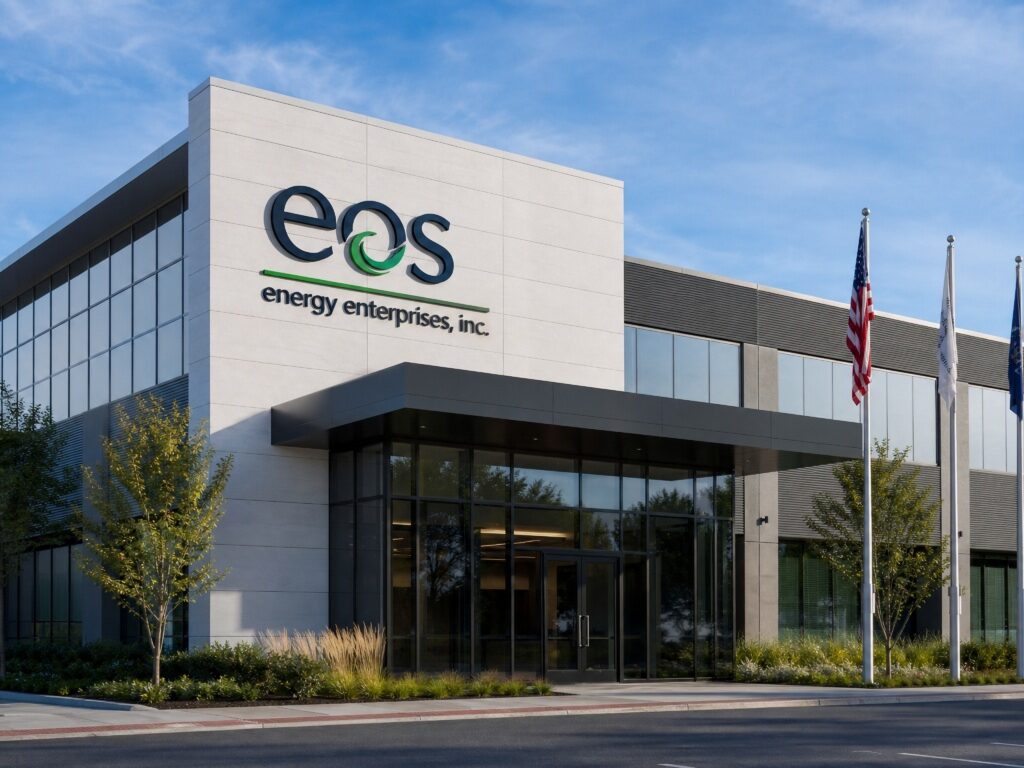
Eos Energy Enterprises, a Pittsburgh-based manufacturer of zinc battery systems, sees the U.S. data center buildout as a growing market for storage that can deliver power for hours at a time. Its preliminary third-quarter update, released Monday, pointed to a planned project with Google and MN8 Energy as an example.
Data centers need dependable electricity as demand rises. Batteries can store solar power for use when sunlight fades, helping a grid serving those facilities meet demand across more hours. Eos’s systems are designed to discharge over roughly four to 16 hours or longer.
“Commercial traction continued across the defense, commercial & industrial (C&I), and data center markets. During the quarter, Eos announced key projects supporting the Golden Dome initiative for mission-critical defense applications and, alongside MN8, a project with Google, highlighting the growing demand for long-duration energy storage systems in data center applications,” the company said in its release.
Eos sees two potential markets for its batteries in the data center industry: systems installed alongside computing facilities and storage at power-generation sites that serve the grid, CEO Joe Mastrangelo told analysts on the company’s August earnings call. He said data center-related opportunities accounted for 32 percent of Eos’s sales pipeline, which represents potential business rather than booked orders.
Mastrangelo cited the company’s work with Talen Energy in Pennsylvania as an example of the second approach.
Eos was still working to qualify batteries for installation directly at data centers and had not announced firm contracts for that use.
“Think of a data center as a factory and think of energy storage or energy coming in as an input for them to produce,” the CEO said in August. “So storage is judged on delivered costs, how fast the site can energize and how reliably it will operate.”
Eos makes its zinc-based batteries in Pennsylvania and has been expanding production at its Thorn Hill plant in Warrendale. It plans to consolidate battery manufacturing there, while Cube assembly, testing and shipping remain at Turtle Creek. The two Thorn Hill lines are expected to provide about 4 gigawatt-hours of annual nameplate capacity once fully operating. Nameplate capacity describes factory design, not current output. Eos is also exploring storage projects at Pennsylvania sites with power producer Talen Energy to serve growing AI and data center demand.
Lawrence Berkeley National Laboratory estimates U.S. data centers used 4.7 percent of the nation’s electricity in 2024. Its central scenario puts that share at 11.8 percent by 2030, with a range of 9.5 percent to 15.3 percent. That growth is pressing developers, utilities and grid operators to find generation, transmission and storage for facilities that may run around the clock. Batteries shift electricity across hours; they do not generate it.
MN8 said in September it would own and operate a West Virginia portfolio combining 86 megawatts of solar, 70 megawatts and 280 megawatt-hours of lithium-ion storage, and a 10-megawatt, 100-megawatt-hour Eos zinc system. Google agreed to buy the project’s energy, capacity and clean energy attributes. The grid-connected portfolio is intended to serve regional demand, including Google data centers. Solar is slated for 2028, lithium-ion storage for 2029 and Eos’s system for 2030. It is the first project under a 750-megawatt-hour MN8–Eos supply agreement.
Eos expects preliminary third-quarter revenue of $82 million to $83 million, up about 169 percent to 172 percent from a year earlier. Shipments rose about 23 percent from the prior quarter. Its second production line, operating on a partial-shift schedule, supplied about 17 percent of battery output. The company had about $765 million in backlog at Sept. 30, representing roughly 3.2 gigawatt-hours of orders it expects to turn into revenue. A $100 million order booked during the quarter was already covered by a capacity reservation and did not add to backlog growth.
The company expects a GAAP gross margin between negative 55 percent and negative 53 percent. Direct production costs thus exceeded sales, although the margin improved roughly 16 to 18 percentage points from the second quarter, its eighth consecutive quarterly improvement. Eos reported about $344 million in total cash, including restricted cash, down from $364 million three months earlier. Its receipts included customer deposits, project payments, tax credits and an $87 million advance under a federal loan facility. Capital spending was about $35 million.
Eos currently expects 2026 revenue in the lower half of its $300 million to $350 million guidance range. It plans to add the final shift at Thorn Hill during the fourth quarter, bringing the plant to 24-hour operations, while completing its manufacturing consolidation and working to lower unit costs. The company plans to report final third-quarter results on Nov. 5.