Data Centers
Data center limits win 36 local votes after balloting in 10 states

Americans overwhelmingly turned thumbs down to data centers in dozens of ballot initiatives across the U.S. yesterday, telling their local governments they don’t want them, and favor either tough restrictions or bans.
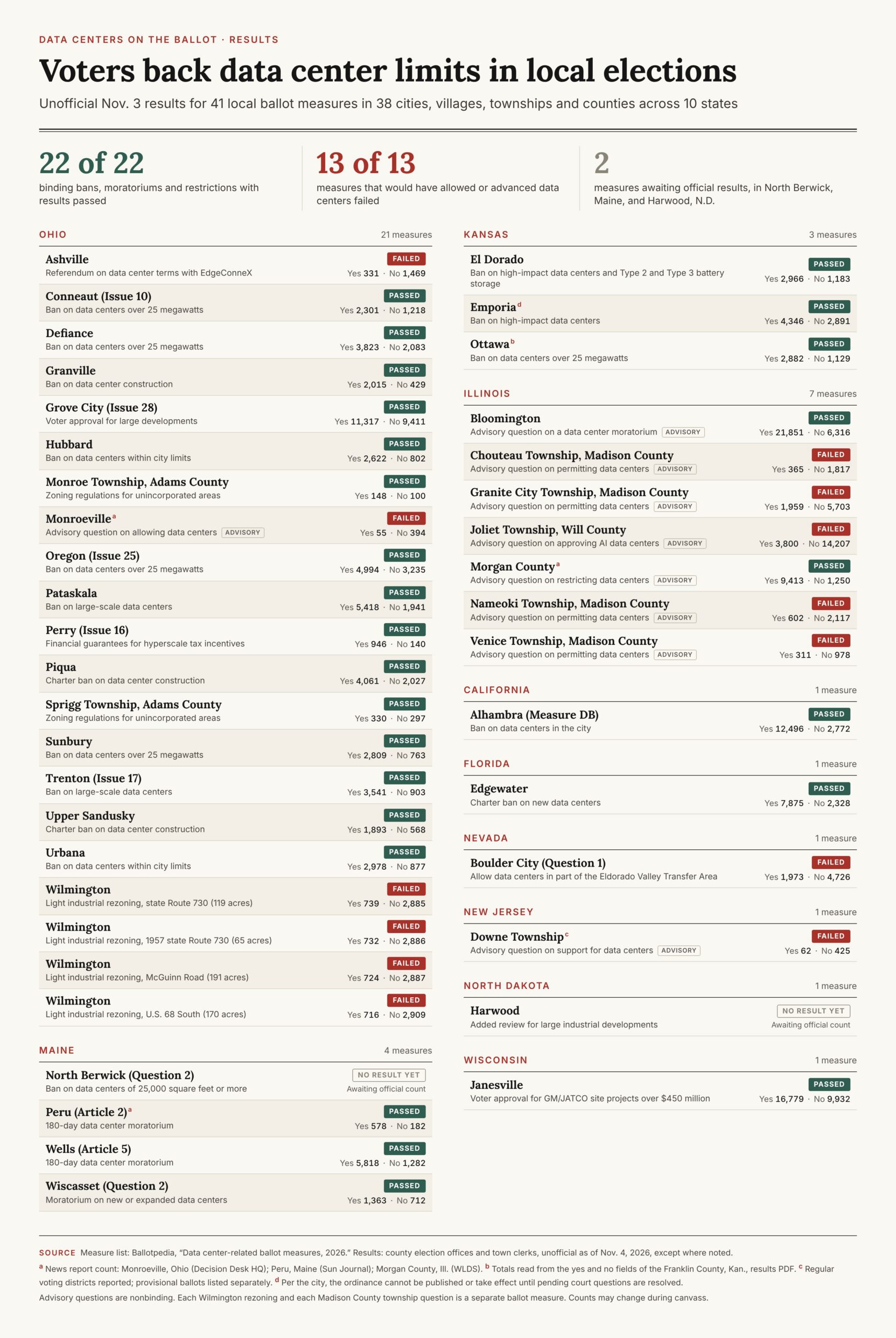
Voters approved every binding data center restriction counted in local returns and rejected all 13 measures that would have advanced development in Election Day referenda held across 10 states.
County and municipal returns and local reports showed 36 of 38 counted measures going against development, including 21 binding restrictions and 15 bans. Results are unofficial.
Ballotpedia listed 41 measures in 38 jurisdictions; this tally excludes Ottawa, Kansas, pending confirmation, and North Berwick, Maine, and Harwood, North Dakota, without official results. Peru, Monroeville and Morgan County rely on news counts. Two Adams County, Ohio, zoning plans remain unclassified.
Pickaway County returns showed Ashville, Ohio, rejecting its village resolution approving a development and supply agreement term summary with data center developer EdgeConneX.
Wilmington rejected four council rezoning ordinances, with roughly 80 percent voting no on each, Clinton County returns show. Clark County returns showed Boulder City, Nevada, rejecting data centers on part of its Eldorado Valley land.
Size thresholds recur across the measures: six Ohio bans target facilities exceeding 25 megawatts; Emporia and El Dorado, Kansas, use 10-megawatt high-impact definitions. Wells, Maine, regulates facilities with at least 100,000 square feet of data center area.
Ten Ohio bans amended city charters. Voters also put Grove City’s approval requirement and Edgewater’s ban into charters. Citizen initiatives put measures before voters in communities including Emporia, El Dorado, Grove City and Perry. Ohio’s county election boards reported the ban results below.
Ohio accounted for 21 measures. Voters approved 11 bans, including those in Conneaut, Granville, Hubbard, Pataskala, Trenton and Urbana. Granville’s charter amendment received 82.4 percent support; Pataskala’s received 73.6 percent. Hubbard voters approved the city’s ban 2,622 to 802.
Perry, a village in Ohio’s Lake County, approved requiring developers seeking tax abatements, payments in lieu of taxes or special-tax deals to post financial guarantees. Lake County returns showed 87.1 percent support, the widest margin among the binding restrictions.
Bans also won in Alhambra, California, with 81.8 percent support, and Edgewater, Florida, with 77.2 percent, according to Los Angeles and Volusia county returns.
In Kansas, Butler County returns showed El Dorado’s ban passing 2,966 to 1,183. Emporia approved its measure 4,346 to 2,891, or 60.1 percent, Lyon County returns showed. Ban support ranged from Emporia’s 60.1 percent to Granville’s 82.4 percent.
Emporia’s ordinance cannot take effect until legal questions are resolved or the court orders otherwise, the city said when placing it on the ballot. A Nov. 4 city statement confirmed that court review remains ongoing.
Maine voters approved three temporary moratoriums. Wells and Wiscasset posted approvals of 5,818 to 1,282 and 1,363 to 712. The Sun Journal reported Peru’s 578-to-182 approval. Wells’ pause applies retroactively from June 16.
Voter-approval requirements passed in Grove City, Ohio, with 54.6 percent, and Janesville, Wisconsin, with 62.8 percent, county returns showed. Grove City had the narrowest restriction margin. Grove City covers developments meeting acreage, power or water thresholds; Janesville covers projects exceeding $450 million at the former GM/JATCO site.
All seven advisory questions favoring data centers failed; both advisory questions favoring restrictions passed. Bloomington, Illinois, backed a moratorium with 77.6 percent support, its election commission reported. Will County returns showed 78.9 percent in Joliet Township voting no on whether the Joliet City Council should approve AI data centers.
Boulder City canvasses Nov. 13. Madison and Will counties in Illinois continue mail and provisional counts through Nov. 17. Emporia awaits its court ruling; North Berwick and Harwood still lack official results.
Referendum Scorecard
Leave a Reply