Data Centers
An NC County moves toward data center pause as it faces larger projects
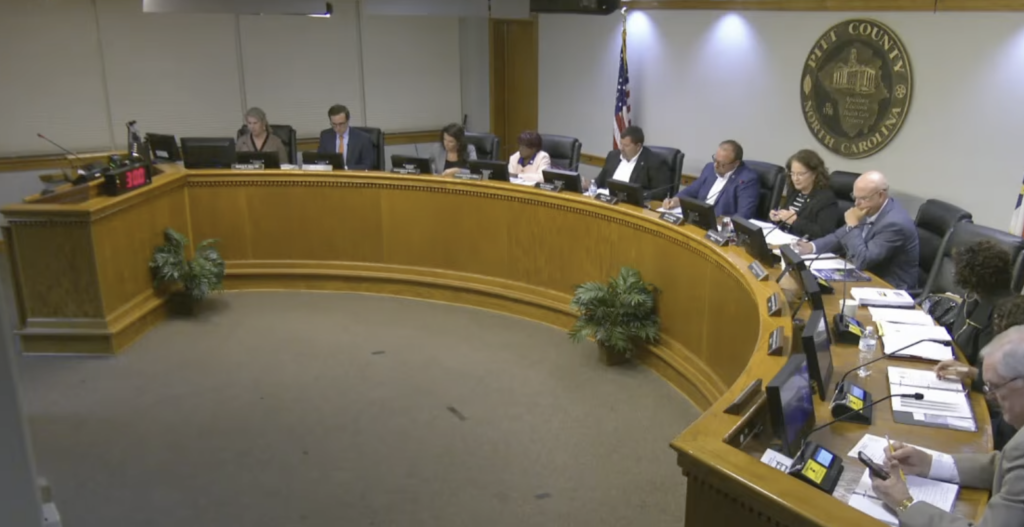
Pitt County, North Carolina, commissioners voted Monday to advance a temporary pause on data center approvals and set a Nov. 16 public hearing. Staff will draft the ordinance, including its duration and the approvals it would cover, before the board makes that decision.
Pitt County already regulates data processing facilities, a legacy of the county’s 2021 response to a proposed cryptocurrency facility. Planning staff told commissioners those rules fall short on the power, water, noise and emergency needs of a modern hyperscale campus.
“It simply lumps everything into one acre or greater,” Planning Director Jonas Hill told the board. “We may need to look at breaking it down and look at more intense and larger scale uses differently than we look at the smaller scale uses.”
The existing ordinance treats a stand-alone data processing facility on at least one acre as a regulated use.
In rural agricultural and some commercial districts, it requires a conditional rezoning that reaches commissioners. Hill said that in light and general industrial districts, a project meeting development standards can receive staff-level review.
The U.S. Census Bureau estimates Pitt County’s population at 182,936 as of July 1, 2025. Its median household income was $58,188 in the 2020–2024 survey. The county sits in eastern North Carolina.
Those standards include a quarter-mile separation from homes, schools and churches and a 50-foot property-line setback. Hill said rural agricultural land where a project could seek conditional rezoning covers about 34 percent of the county’s planning jurisdiction. Pitt County’s zoning rules apply outside municipal zoning jurisdictions.
The county’s action follows a growing use of temporary pauses while local officials rewrite data center rules. Durham, North Carolina, has a city moratorium in place through May 3, 2027, while staff develops land-use rules. Hill told Pitt commissioners that staff had identified about 24 North Carolina counties with data center moratoria, while warning that the count was changing quickly.
Other communities are tightening permanent standards while continuing to accept applications. Fairfax County, Virginia, adopted revised data center zoning in 2024, adding residential setbacks, equipment screening and noise studies before and after construction. Across those responses the questions repeat: how much land, power and water a facility needs, what neighbors will hear, and how much of the supporting infrastructure a community must accommodate.
A U.S. Department of Energy-backed study estimated that data centers used 4.4 percent of U.S. electricity in 2023 and projected a 6.7 percent to 12 percent share by 2028. In Pitt, the immediate question is whether an ordinance written around one-acre facilities gives the county enough information and authority to evaluate a 500-acre hyperscale campus.
Hill said the current rules require utility approval but set no specific review standard for large electrical loads, substations or transmission corridors. They also lack standards for water demand or groundwater use. Chairman Mark Smith asked whether staff would work with the county’s water providers, citing past pressure on local aquifers. Hill said he would recommend consulting both water and electric providers as the rules are developed.
Noise and backup power are another gap. The ordinance calls for an acoustical study during approval, but Hill said it does not require testing after construction or periodic checks as equipment ages. It also does not address generator testing schedules or emissions from multiple generators, and it has no specific standards for battery storage or the fire response that such systems may require. Staff wants to examine screening, phased campus expansion and financial assurances for site restoration when a facility closes.
The board also discussed an industrial megasite in northwestern Pitt County. Its zoning could allow a data center under current development standards, Hill said, but the site has received state funding intended to promote manufacturing. County officials are seeking written guidance on whether a data center there would put that funding at risk. Commissioner Mary Perkins-Williams stressed that the board has not approved megasite development. County Manager Janis Gallagher said environmental and infrastructure studies are still pending and will return to commissioners before the board decides whether the land is suitable for major industrial development.
Residents at Monday’s meeting urged a stronger response. Don Cavallini, a local advocate, supported a moratorium and eventual ban on hyperscale projects. Molly Holdeman thanked commissioners for taking up the issue and credited Commissioner Melvin McLawhorn, who had initiated the discussion and was absent Monday. Hill told the board that state law permits a reasonable, time-limited moratorium to address identified problems and requires the county to accommodate a lawful land use.
Staff will now prepare the proposed ordinance and publish notice for the Nov. 16 hearing at 6 p.m. Commissioners can hear public comment and act on the pause then. The longer job is a unified development ordinance update, which county consultants said will include data centers; technical drafting is expected to begin in December, with community meetings planned for January 2027 and final adoption targeted for October 2027.